
Le collier rouge des reines nues
Galerie Claire Corcia | March 6 – April 12, 2025
The exhibition Le collier rouge des reines nues was presented at Galerie Claire Corcia in Paris. It ran from March 6 to April 12, 2025. As part of it, Honargardi had the opportunity to speak with the artist. The conversation covered her creative universe, artistic practice, and the ideas that shape her work.
Working across painting, drawing, printmaking, contemporary embroidery, installation, and collaborative performance, she has developed a multidisciplinary visual language. This language explores the relationships between memory, nature, femininity, mythology, dreams, and the unconscious. Her works invite viewers into poetic, hybrid worlds where symbolism and intuition coexist. They encourage multiple interpretations rather than fixed narratives.
In this conversation, the artist reflects on her creative process and the influence of textile traditions. She discusses the symbolism behind The Red Necklace of the Naked Queens. The role of altered states of consciousness in artistic creation is also part of this reflection. She also reflects on the impact of travel, collaboration, and social engagement on her practice. In addition, she shares her thoughts on ecofeminism, art education, and the responsibility of artists in today’s world.
The following interview has been lightly edited for clarity and readability.
Artistic Vision & Creative Process
Your work spans painting, drawing, engraving, and contemporary embroidery. So, how do you decide which medium best serves a particular concept?
Painting on canvas, drawing on paper, engraving, and embroidery each require a different state of mind. Depending on my inner state, I choose to paint with oil. This happens when I need to express more physical or intuitive emotions. I turn to engraving when I need to bring order to my thoughts or shift my perspective. Drawing suits me when I don’t have long periods of time ahead of me, or when I lack space. I also draw when my schedule is overloaded or when I need to focus. As for embroidery, it is an interesting practice for developing my formal repertoire and refining my gestures. It also helps me explore new themes and expand my color palette.
In fact, I need to change mediums, tools, formats, and techniques because these changes renew my creativity. Each medium requires different neural connections. The more I renew these connections, the more I feel my creativity expanding. The brain is as plastic as the art I practice!
Your artistic journey has evolved across multiple disciplines and influences. In particular, how do you see your early background in textile design shaping your current artistic language?
Textile Influences and Symbolic Imagery
The study of textiles, their history, and the diversity of techniques across the world is a source of inspiration. It is incredible and inexhaustible. I have a strong attraction to patterns and love creating color palettes. I also pay great attention to the details of my compositions.
On a symbolic level, thread has a unifying power: it connects stories, mends, assembles, weaves, and knits. Textile techniques such as weaving, knitting, and embroidery have a special relationship with time. It is a long, cyclical time that unfolds in stages.
In my painting and engraving work, I find a similar step-by-step approach. It alternates between purely gestural and technical phases and more cerebral moments of intuition. This meeting of the manual and the intellectual feels deeply enriching and profoundly nourishes my artistic language.
The imagery in your work often blends human figures, animals, and surreal landscapes. Specifically, what draws you to these hybrid forms, and what narratives do they carry?
My works explore the intimate relationship between living beings and nature, their interconnections beyond a defined time and space. I do not seek to tell specific stories. My work, I believe, is connected to the world of dreams and the depths of the unconscious. I simply place a few markers, a few clues that allow each person to construct their own story. This depends on their frame of reference and their ability to associate ideas, letting their own narrative emerge.
I am often drawn to combining shapes or objects that do not appear to be connected. My aim is to create a world that is less expected and less binary. I want to blur boundaries and challenge our certainties.
Your practice extends beyond traditional painting into installation and live performance collaborations. As a result, how does interdisciplinary work inform your creative process?
Themes & Symbolism
The red necklace is a recurring motif in your exhibition, The Red Necklace of the Naked Queens. In particular, could you elaborate on its symbolic significance in the context of femininity and societal expectations?
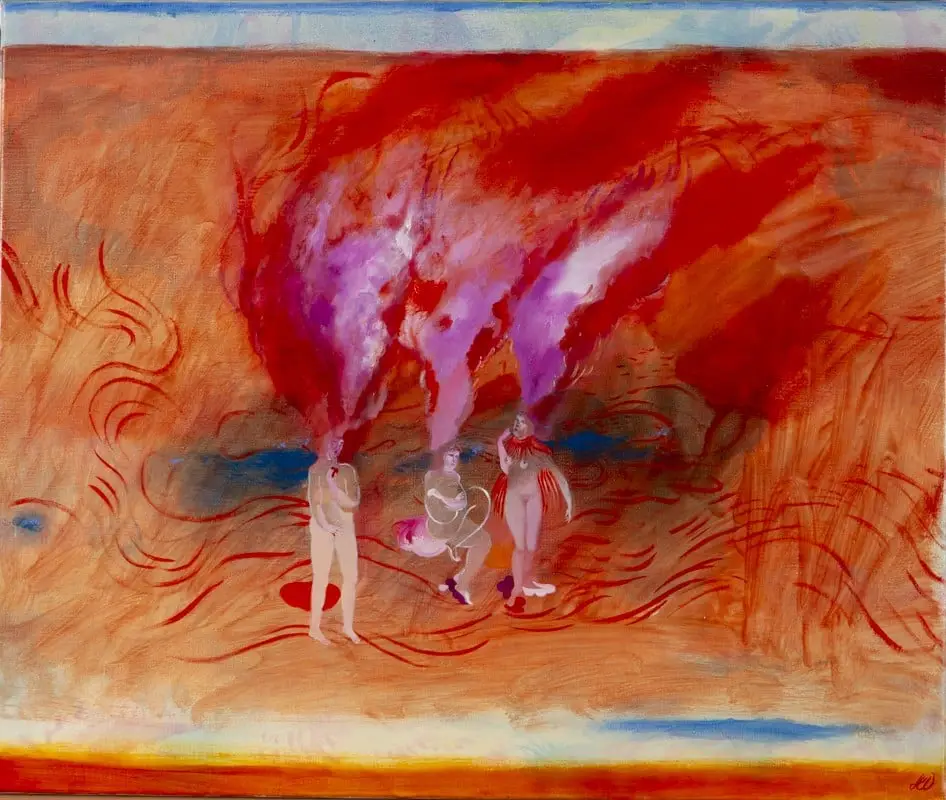
The red necklace symbolizes the feminine cycle, which alternates between pain and ecstasy, power and invisibility. In many places, being a woman remains a struggle. I wanted to give space to this intimate yet universal aspect. It both questions and moves through me. Pearl necklaces embody both a secret bond between women and the weight of an imposed role. They sit somewhere between ornament and constraint, between transmission and burden.
Your work often explores themes of connection, vulnerability, and transformation. Naturally, do these themes arise organically, or do you intentionally construct narratives around them?
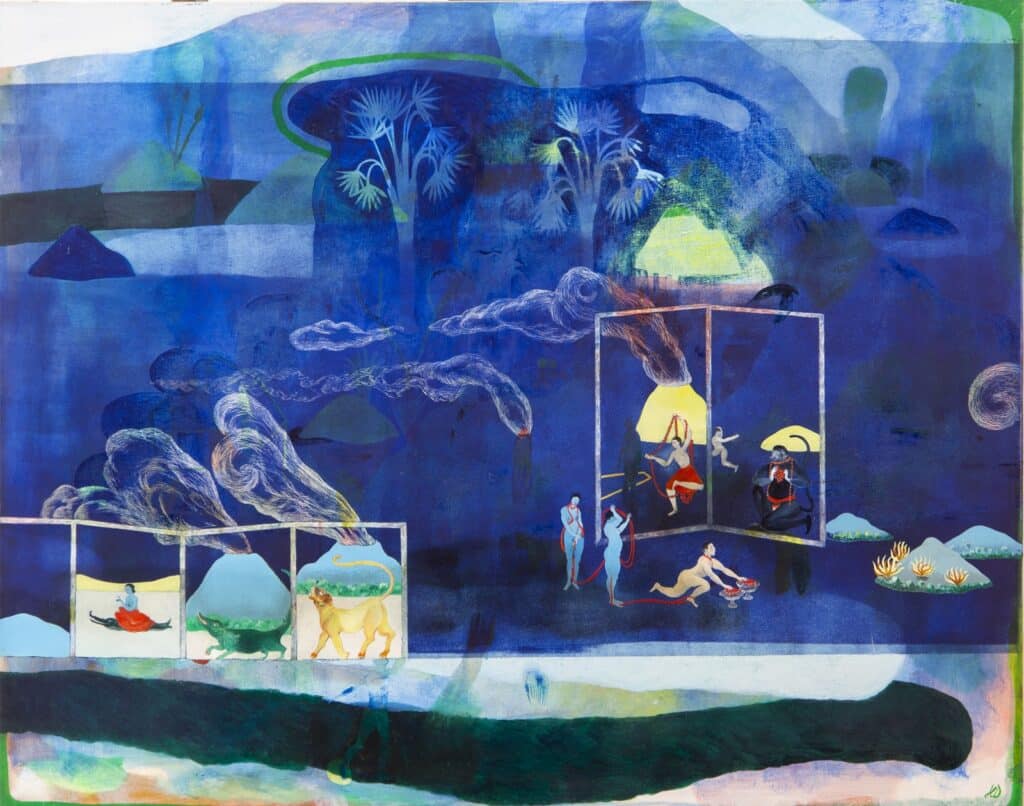
In my work, one can indeed find representations of motherhood, evocations of psychiatric illness, and duality. Other recurring elements include the sacred, magic, rituals, sexuality, and the collective. I also paint trees, rivers, fountains, plants, and animals. Within these motifs, I incorporate the idea of hybridization. Deep down, nothing is exactly as reality leads us to believe. Behind appearances, things are more complex. I invite the viewer to question their own certainties.
Impermanence and Altered States of Consciousness
I am interested in the concept of impermanence and in the Japanese notion of Ma. It is a concept that intertwines time and space into a single idea. Ma signifies interval, duration, space, and distance. It refers to the subjective variations of emptiness that connect two separate objects or phenomena.
I have an endless reservoir of inspiration within me. These ideas surface and disappear from day to day. I activate and deactivate them, and they evolve indefinitely in response to my experiences.
I believe my work contains a tiny element of intentionality and a vast amount of improvisation. However, I pay close attention to rhythm, color, and composition. I see them as a way to create space for the viewer’s eye to wander and construct their own narrative.
You’ve mentioned an interest in altered states of consciousness as a tool for creativity. Specifically, how do these states manifest in your artistic process?
Hypnosis is simply a mental tool that complements my physical tools. This altered state of consciousness allows me to open my perceptions in a way that fosters creation. It is a state where one disconnects from one reality to connect with another, more internal, more meditative reality. It is a unique inner space where the thoughts I leave behind continue to bloom. There, I can gather new ones, sort them, reorganize them, experiment, and take creative leaps. In this space, I seek the unexpected and the rare. I also seek a sense of freedom that is difficult to attain.
Above all, hypnosis allows me to stop caring about what is expected of me.
The relationship between ornament and constraint is central to The Red Necklace of the Naked Queens. Accordingly, how do you see this duality reflected in women’s experiences across cultures?
Influences & Inspiration
Your artistic development has been influenced by diverse encounters, including your training with Hélène Laflamme and Xuan Chieu. Overall, what key lessons from these experiences continue to shape your work?
For two years, I learned oil painting on gessoed wood with Hélène Laflamme, following the traditional icon technique. This craft demands immense rigor and patience. This is especially true in preparing the surfaces and grinding pigments before even beginning to create. For several weeks, the wood must be carefully prepared. This involves applying seven layers of gesso mixed with animal glue. Each layer must dry before being delicately sanded. It is a demanding process, both physically and mentally, requiring deep concentration.
In Ho Chi Minh City, I spent three months learning lacquer techniques with Xuan Chieu. These techniques follow a similar process. Multiple layers of resin are applied, left to dry, and then sanded down extensively. This is sometimes done using the palm of the hand.
These experiences reinforced lessons I had previously learned through weaving and embroidery. They gave me a unique relationship with time, space, and material. It felt very different from the way we usually experience them in daily life. They also helped me understand the importance and magic of alternating between highly technical phases and purely creative moments. This time devoted to meticulous, almost hypnotic and ritualized gestures is fertile. It lays the groundwork, much like a farmer cultivating the land before harvesting its fruits.
Travel, Social Engagement, and Sources of Inspiration
You’ve traveled extensively, particularly in Africa and Asia. As a result, how have these journeys informed your perspective as an artist?
Your works often resonate with current events and social issues. Given this, how do you balance personal expression with broader socio-political commentary?
It’s true that I listen to a lot of radio documentaries and biographical stories. I’m particularly interested in currents of thought in the humanities and social sciences, especially ecofeminism. It seems to me the best political path we can offer our children and the Earth.
With all these threads, I knit, sew, cook, raise my children, paint, draw, tinker, talk, dream, sleep, write, read, walk, see, create connections, and think.
Also, who are the artists, writers, or thinkers that inspire you the most?
My sources of inspiration are countless: literature, poetry, music, painting, dance, philosophy, theater. But if I had to choose just one, I must admit something. I love going to contemporary circus performances. Over the past few decades, the world of circus has evolved tremendously. I have seen shows that bring together all forms of art, along with science and philosophy.
Companies like Le Baro d’Evel, Johann Le Guillerm, Compagnie Jérôme Thomas, Nikolaus, Cirque Trottola, and Cirque Pardi!—and I’m sure I’m forgetting many—create complete, total works. These works merge all art forms, science, and philosophy. These performances are so intense and dazzling that a single show can inspire me for years.
Exhibitions & Projects
Your participation in Art Central HK will introduce your work to an international audience in Asia. In that light, how do you anticipate different cultural contexts influencing the reception of your work?
I’ve learned not to expect too much. Instead, I try to receive the small signs of appreciation for my work as a gift. In an ideal life, I would love to have the opportunity, one day, to present different periods of my work. I’ve been painting for 25 years. I imagine doing this in a beautiful space, with a lovely floor and beautiful lighting. I picture intimate areas alongside others that are more open. That would be the dream!
Your collaborations with other artists, institutions, and collectives seem essential to your practice. Specifically, how do these collaborative projects differ from your solo work?
For two consecutive years, you’ve designed the visual identity of the Nantes Conservatory’s cultural season. In contrast, how does working on applied art projects differ from your personal artistic practice?
The Role of Art in Society
Beyond your studio practice, you are involved in initiatives advocating for artists’ rights and ecological concerns. Given this, what role do you believe artists should play in shaping cultural and environmental discourse?
There are as many ways to be an artist as there are to be a citizen of the world. In my eyes, being an artist is already a deep and demanding commitment. Living from one’s art involves many compromises. Today more than ever, culture in all its diversity is threatened. So too are education, healthcare, the climate, and many other essential aspects of our societies.
We must collectively rethink how to create a true “common good,” because, in my view, individualism is a destructive model. As an artist, a mother, and a global citizen, I feel the need to resist the erosion of life. I want to resist the questioning of models based on emancipation through education and culture. I also want to resist the weakening of peace, critical thinking, and our ability to build rather than destroy.
Art Education and the Next Generation
Art often serves as a space for reflection and resistance. Accordingly, do you see your work as a form of activism?
I wish I could be more of an activist and militant, but like many, I face certain constraints. Ensuring daily life, feeding my children, and keeping a roof over our heads takes real effort. It requires me to dedicate part of my time to “survival” work. Juggling this necessity, my artistic practice, and family life leads to physical and mental fatigue. This limits my direct involvement.
However, I do my part in my own way, through my works. I infuse them with my convictions and vision of the world.
You’re also involved in educational and participatory projects. Given this, how do you see the role of art education evolving in today’s society?
Offering children and young people the opportunity to explore materials, play with colors, and create shapes has real value. So does sharing moments of reflection and collective creation around a common project. It allows them to discover values different from those promoted by television or social media.
Creating with one’s hands activates new areas of the brain. It stimulates cognitive abilities that complement those developed in a traditional school setting. This brings out new skills, but also new emotions.
It is essential to give young people the chance to learn to use their hands as much as their minds. Cooperation matters just as much—partnering with others, valuing their complementary strengths, and fully experiencing the emotions linked to creation. By strengthening our emotional system, we develop a deeper connection with the world around us.