
Since 7 October 2026, visitors who come to the Louvre’s Hall Napoléon for the Zurbarán retrospective have found a second exhibition waiting in the same space. Sculpting Colour: Masterpieces from the Museo Nacional de Escultura, Valladolid, on view until 25 January 2027, brings together twenty-three sculptures, all lent by the Spanish national museum devoted to sculpture under what the Louvre describes as an exclusive partnership. According to the museum’s press office, it is the first time 17th-century Spanish sculpture has been presented in this way in France.
It would be easy to treat the show as a supplement to the painting retrospective next door. That would be a mistake. The two exhibitions were designed together, with a joint scenography by Nathalie Crinière and a single ticket for both, and the decision to stage them side by side makes an argument: that Spanish painting of the Golden Age cannot be fully understood without the carved and painted images that filled the churches, convents and streets where it was made.
A procession at eye level
The first room is given over to the exhibition’s most ambitious loan: a complete paso, the Camino del Calvario (Road to Calvary) by Gregorio Fernández, the leading sculptor active in Valladolid in the early 17th century, when the city was briefly the capital of the kingdom. The group consists of five life-size carved and painted figures. Such ensembles were made to be carried through the streets during Holy Week, seen from below and in motion. At the Louvre they are set at human height, a choice the curators explain as a way to allow the most direct observation possible.
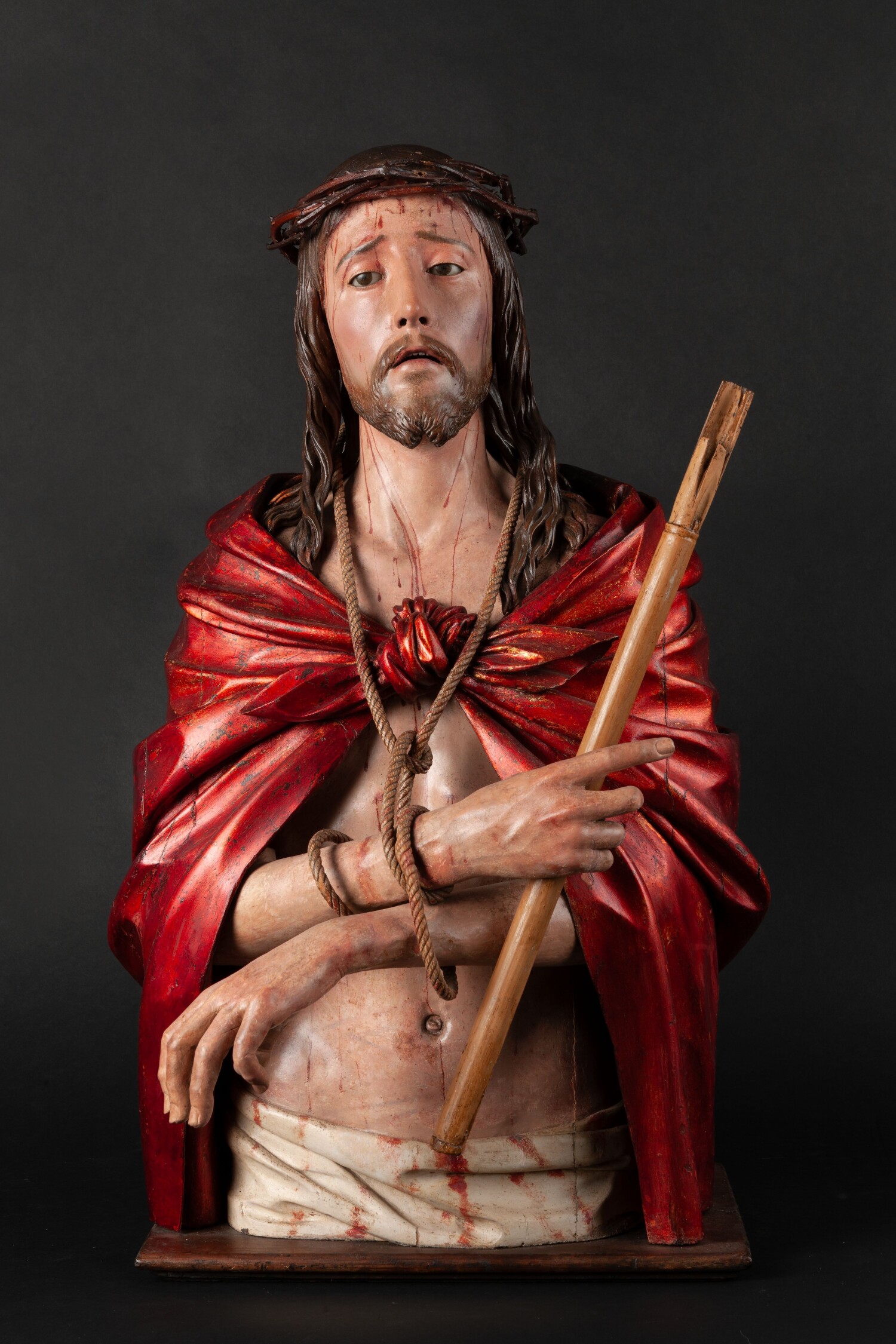
The effect is double-edged, and productive. Removed from the procession, the figures lose the theatre of the street but gain scrutiny: the viewer can study the carving of a face, the painted flesh tones, the cut of a garment, as one would a painting. That shift from devotional spectacle to museum object is, in a sense, the subject of the whole show.
Relics, dressed statues and private devotion
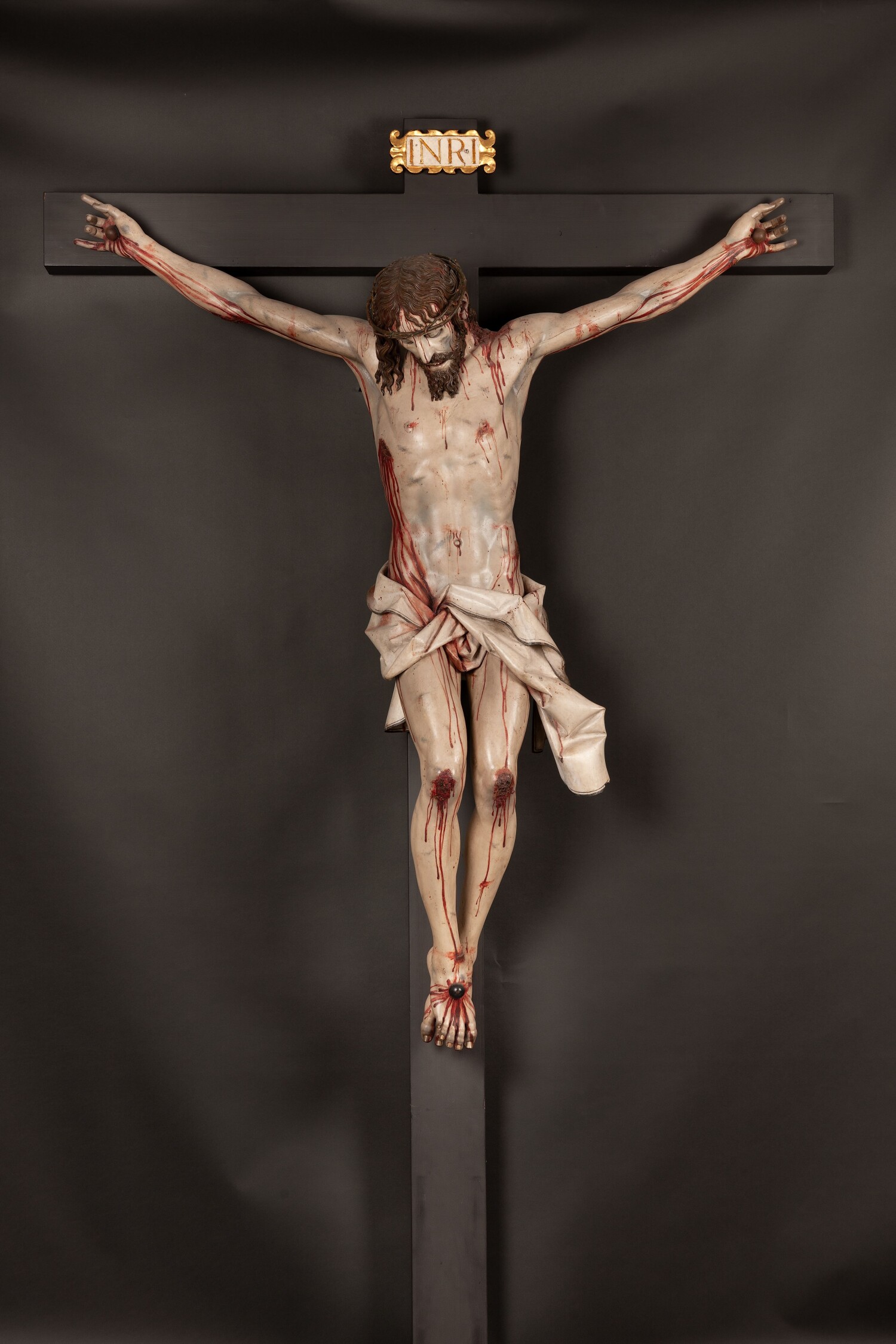
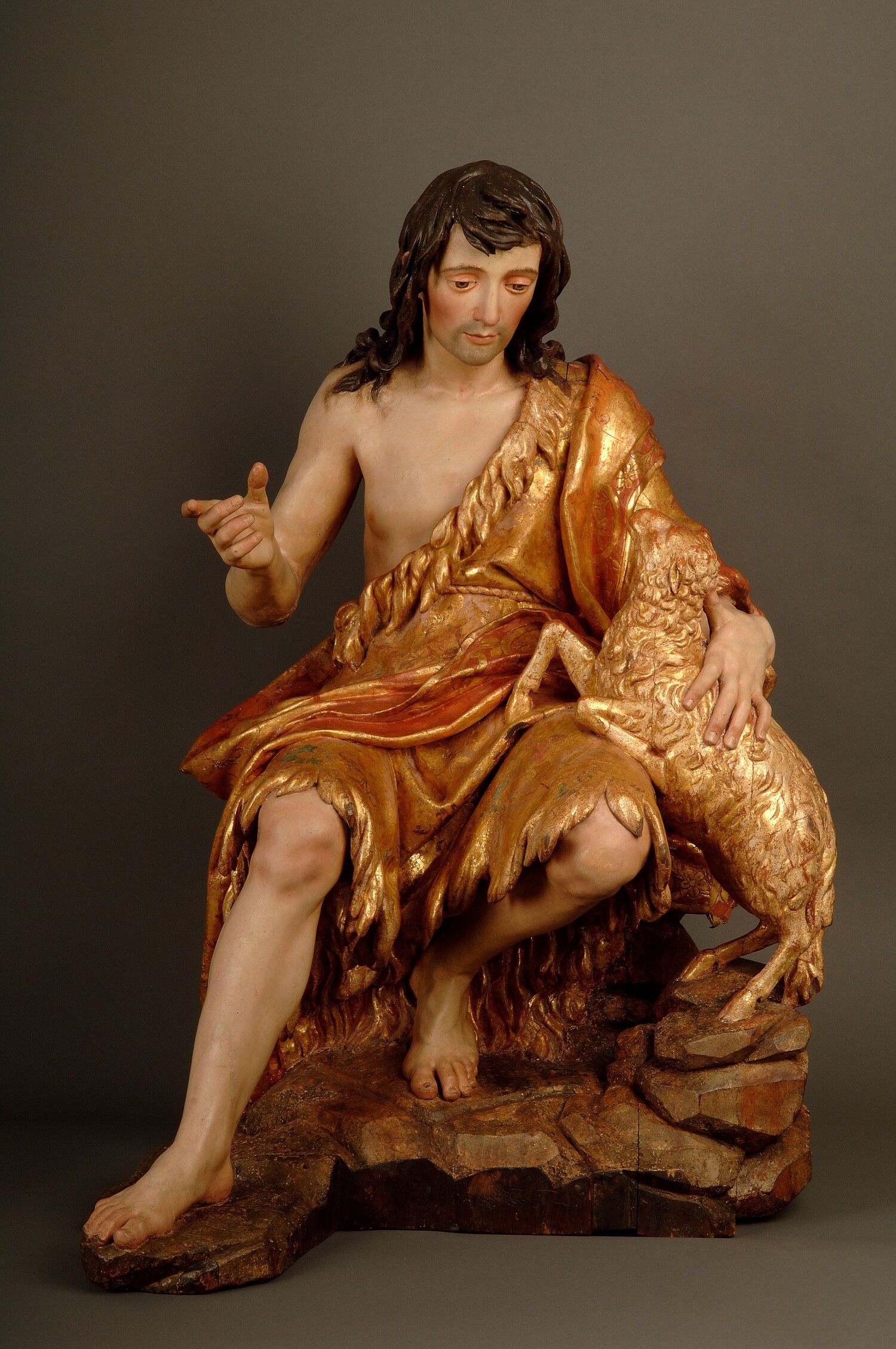
From there, the route follows several themes set out by the curators: the cult of relics and the role of intercessor saints, dressed statues, the representation of the sufferings of Christ and the Virgin, private devotion, and the Immaculate Conception. Among the major loans, none previously seen in France according to the Louvre, are Fernández’s Cristo de la Luz, a life-size crucified Christ, and Alonso Cano’s Saint John the Baptist. Cano is an instructive case: better known today as a painter, he painted his own sculptures, embodying in a single career the close ties between the two arts that the exhibition sets out to demonstrate.
The roster of sculptors goes well beyond Fernández and Cano: Juan de Mesa, José de Mora, Pedro de Mena, Jerónimo Francisco and Miguel Jerónimo García, José de Arce, Pedro Roldán and his daughter Luisa Roldán, whom the press release singles out as one of the rare women of the period to build a brilliant career that reached the royal court. Two works shown here, Luisa Roldán’s Virgin and Child with Saint John the Baptist and Pedro de Mena’s Immaculate Conception of 1680, are recent acquisitions of the Valladolid museum, presented after what the Louvre calls spectacular restorations.
Why the pairing matters
A single painting forms the hinge between the two exhibitions: Zurbarán’s Holy Face, also lent by Valladolid, serves as a shared introduction. It shows the miraculous imprint of Christ’s face on Veronica’s veil, and the curators use it to name the challenge common to painters and sculptors of 17th-century Spain: to render, with the greatest possible exactness and naturalism, the intrusion of the sacred into ordinary reality.
Seen in that light, Zurbarán’s stillness, his sharply modelled monks and saints against dark grounds, starts to look like a painter’s answer to what sculptors were achieving in three dimensions, and vice versa. For a French public whose idea of Spanish art of the period has been shaped largely by canvases, this is the exhibition’s most valuable lesson. Polychrome sculpture, long held at arm’s length by a museum culture that preferred marble and bronze, is presented here not as folk devotion but as an art of the first rank.
The exhibition is compact, with an average visit of around 45 minutes according to the museum, and that restraint serves it well. Rather than survey a whole field, it lets a small number of exceptional objects carry the argument.
Practical information
Sculpting Colour: Masterpieces from the Museo Nacional de Escultura, Valladolid. Musée du Louvre, Hall Napoléon, Paris. 7 October 2026 – 25 January 2027. Curators: Valérie Carpentier-Vanhaverbeke, chief curator, Department of Sculptures, Musée du Louvre, and Alejandro Nuevo Gómez, director of the Museo Nacional de Escultura, Valladolid. A ticket gives access to both this exhibition and Zurbarán 1598–1664; full price €22 for EEA residents and €32 for non-EEA visitors, with free admission under conditions. Short 20-minute introductory tours run on Wednesday and Friday evenings. Catalogue: Musée du Louvre / Liénart, 168 pages, 76 illustrations, €29. The exhibitions are accompanied by a cultural season, “L’Espagne au Louvre”.
Sources: Official exhibition page, Musée du Louvre · Musée du Louvre press room
This article was prepared with AI assistance and reviewed by the Honargardi editorial team.