
Paris – The artist duo Brognon Rollin, David Brognon and Stéphanie Rollin, has won the 2026 Prix Marcel Duchamp. The award was announced on Thursday 22 October at the Musée d’Art Moderne de Paris, according to The Art Newspaper France and Le Journal des Arts. The jury chose them over the three other nominees, Joël Andrianomearisoa, Laura Henno and Josèfa Ntjam, for the installation they made for the prize exhibition, titled “5 376 années, 1 892 mois, 1 110 jours, 1 201 heures” (5,376 years, 1,892 months, 1,110 days, 1,201 hours).
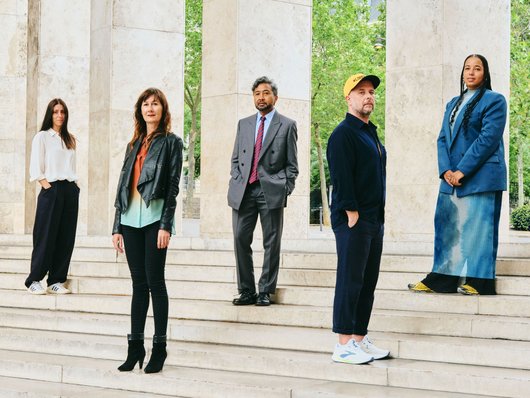
The prize, now in its 26th edition, is worth €90,000 in total, of which €35,000 goes to the winning artist, according to the Centre Pompidou’s press release. It was created in 2000 by ADIAF, the association of French-art collectors, and is organised in partnership with the Centre Pompidou. For the second time it is hosted by the Musée d’Art Moderne de Paris, because of the renovation of the Pompidou building; the press release says the exhibitions will stay there until 2029.
The winning work
According to The Art Newspaper France, the duo conceived “temporal sculptures” for a darkened room: coin-pusher machines of the kind used at funfairs, which move at intervals to present a collection of sobriety tokens. The tokens, the newspaper reports, were distributed around the world in groups for people recovering from alcohol, gambling, cocaine and sex and love addiction, and each attests to a period of abstinence.
Le Journal des Arts adds that the tokens have been collected since 2022 and represent more than 5,000 years of abstinence in total, and that three connected light fixtures in the installation respond to information supplied by a person who has been abstinent for eight years. The paper describes the work as setting the duration of abstinence against the permanent possibility of relapse. These details come from that single outlet.
The Art Newspaper France quotes the duo’s gallery, mfc-michèle didier, as saying that Brognon and Rollin work with raw, often marginal social material whose recurring motifs are confinement, waiting and control. Their first institutional solo show was at the MAC VAL in Vitry-sur-Seine in 2020, both outlets report.
The jury and the reactions
The jury was chaired by Xavier Rey, director of the Musée national d’art moderne – Centre Pompidou. Its other members, as listed by The Art Newspaper France, were Claude Bonnin (collector and ADIAF president), Akemi Shiraha (Association Marcel Duchamp), Fabrice Hergott (director of the Musée d’Art Moderne de Paris), the collector Fernando Arriola, the artists Kader Attia and Berlinde De Bruyckere, Karin Hindsbo (director of Tate Modern), Christophe Leribault (president-director of the Louvre) and the collector Marie-Cécile Zinsou.
In statements reproduced by The Art Newspaper France, Bonnin, speaking for ADIAF’s roughly 300 collectors, praised the duo’s conceptual rigour and said the four nominees would be supported in the coming years, including through exhibitions abroad and residencies at the Villa Albertine and the Manufacture de Sèvres. Hergott said the work gives material form to the time of waiting, addiction and intimate resistance, and Rey said it reveals a part of intimacy that speaks to everyone.
The same outlet notes that the ceremony took place during Paris art week, which it says was hit by a social movement that forced Art Basel Paris to close early before the weekend.
Practical information
Exhibition of the four nominees: Musée d’Art Moderne de Paris, 2 October 2026 – 7 February 2027, free admission, curated by Odile Burluraux (Musée d’Art Moderne de Paris) and Nicolas Liucci-Goutnikov (Centre Pompidou), according to the Pompidou press page.
Sources: Centre Pompidou, press release “Prix Marcel Duchamp 2026” · The Art Newspaper France, 22 October 2026 · Le Journal des Arts, 23 October 2026
This article was prepared with AI assistance and reviewed by the Honargardi editorial team.