
Between Heritage and Creation: A Conversation with Louis-Ange Maucarré
In contemporary art, innovation is often associated with breaking away from tradition. Yet for some artists, true originality emerges not from rejecting the past but from entering into a meaningful dialogue with it. Among them is Louis-Ange Maucarré, a French painter whose work draws profound inspiration from the artistic traditions of Persian and Ottoman miniature painting.
His paintings are not mere reproductions of historical aesthetics. Rather, they represent an ongoing exploration of the intellectual, philosophical, and visual foundations that gave rise to these remarkable artistic traditions. Through meticulous craftsmanship, extensive historical research, and a deeply personal artistic vision, Maucarré seeks to build a bridge between centuries-old cultural heritage and contemporary artistic expression.
In this exclusive interview with Honargardi, Louis-Ange reflects on his artistic journey, the influence of Persian philosophy and miniature painting, the importance of craftsmanship, and the responsibility of engaging with a cultural tradition beyond one’s own origins. He also shares his thoughts on art education, creative integrity, and the enduring relevance of slow, deliberate artistic practice in an age driven by immediacy.
Rather than offering definitive answers, this conversation invites readers into the thoughtful world of an artist who believes that understanding the past is not an obstacle to creativity, but one of its richest foundations.
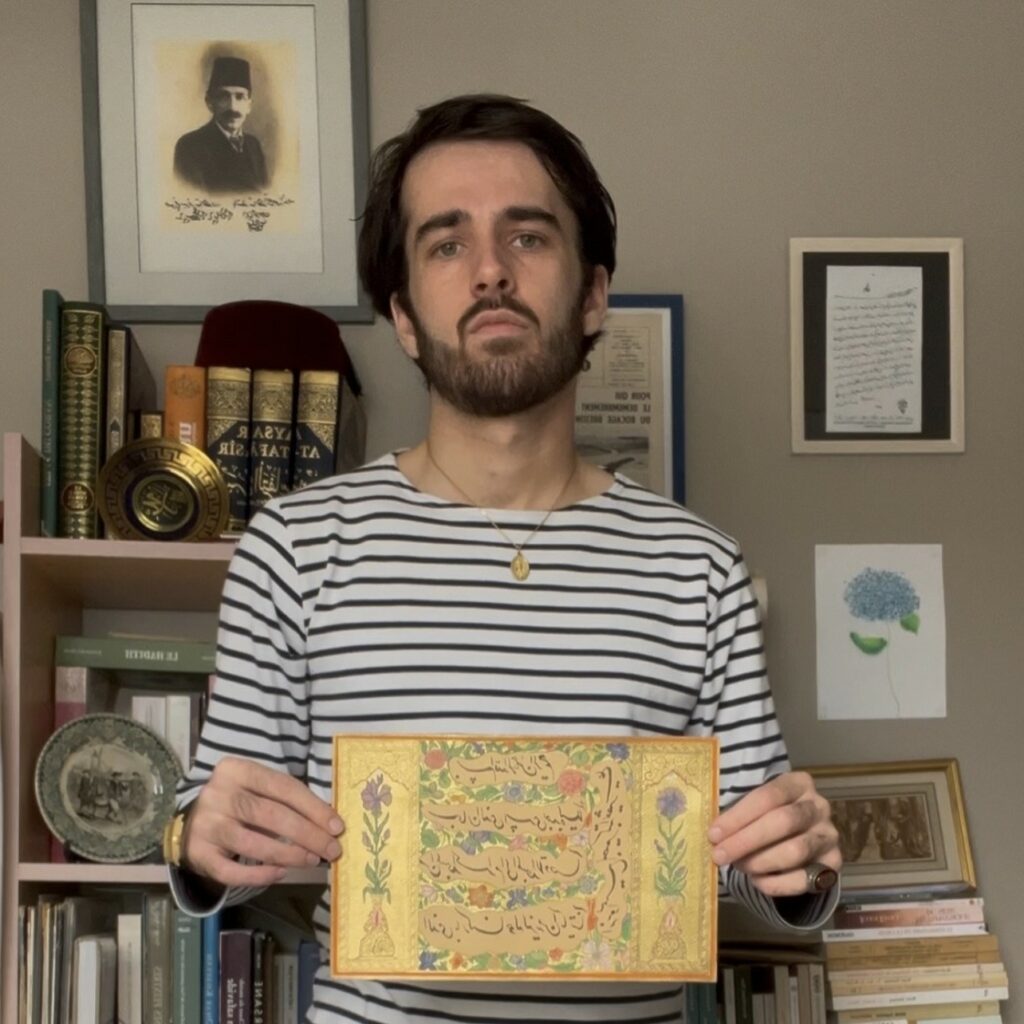
You are a young French artist, yet your work is deeply inspired by the artistic traditions of Persia and the Ottoman Empire. How did you first encounter these traditions?
There was no encounter in the dramatic sense of the word—no sudden revelation while standing before a museum display case. My grandfather was an orientalist, and I admired him profoundly. We often spoke about those worlds. I believe he passed on something essential to me: a sense of curiosity, a rich imagination, and a particular inner disposition.
Miniature painting came later, through my own research. At the time, I was already devoted to academic drawing—anatomy, architecture, and so on—and exploring different artistic worlds. When I discovered these works, I was immediately captivated by their visual language: this way of constructing an image in which color, ornament, and narrative follow principles that were radically different from anything I had previously known.
From there, it gradually became a process of study: the techniques, the materials, the great manuscript traditions, and above all, the worldview that made these works possible. Reading thinkers such as Henry Corbin and Christian Jambet later allowed me to rediscover this art from yet another perspective.
What was your first encounter with Persian or Ottoman miniature painting? Do you remember the moment when this artistic universe first fascinated you?
Honestly, no.
I have no clear memory of a first encounter. It happened gradually, through accumulation rather than a single defining moment. What I do remember is a certain quality of attention that these images began to demand of me. They are not works you can simply glance at in passing.
What held my attention—and still does—are the paintings of the Shahnameh. Not because I could clearly explain why at the time. Simply because there was something within them that refused to reveal itself immediately, and that made me want to stay with them.
What attracts you most about these ancient artistic traditions?
What fascinates me is everything that lies behind them.
These images did not emerge from nowhere. Behind them were entire workshops, systems of patronage, sultans who financed, commissioned, selected, and sometimes collected manuscripts with genuine obsession. It was an art that was profoundly political—in the noblest sense of the word.
Every illuminated manuscript was also a demonstration of power. Yet within that framework, artists still managed to introduce something that truly belonged to them. That tension between commission and freedom, between service and personal expression, speaks directly to me.
Many contemporary artists seek to break away from the past. Your work, on the contrary, seems to engage in a dialogue with it. Why have you chosen this path?
I did not really choose it; it is simply a matter of temperament.
What would the alternative have been? To ignore five centuries of painting in order to produce something supposedly “contemporary”?
I have never understood the desire to wipe the slate clean. It strikes me as intellectually impoverished, and a little presumptuous. Breaking away from something you have never truly experienced cannot be called freedom.
What interests me is dialogue—not reproduction, but neither pretending that the past does not exist. I am interested in creating something alive, something that knows where it comes from.
You often work from historical sources. How do you reconcile fidelity to tradition with personal expression?
I did receive a traditional education, yes. But eventually I moved beyond it. Some temperaments naturally do that—not out of rejection, but because there comes a point when the framework begins to constrain more than it guides.
Today I work as a self-taught artist, searching for a voice that is uniquely my own. I have no interest in reproducing what has already been accomplished with genius. I want what I create to be something that could only have come from me.
Among the works you have created so far, which do you consider the most important or the most representative of your artistic vision?
The one I am working on right now.
It is a gouache diptych executed in the style of the Safavid Persian tradition, yet supported by a level of research and invention that distinguishes it from everything I have produced so far.
I have always believed that the most important work is the one that is not yet finished, because that is where my thoughts truly reside at the present moment.
What role do literature, poetry, and historical narratives play in your work?
What nourishes me on a daily basis often has very little to do with what I paint.
Jacques Rigaut, Joséphin Péladan, Roger Gilbert-Lecomte, Tristan Tzara, Chet Baker, Nijinsky, Wagner, Daniel Darc—there is almost nothing Persian among them.
And yet I am convinced that all of it is somehow present in my work. Not in an obvious way, nor as references that one could easily point to. Rather, they exist as a disposition, a certain way of demanding things from oneself.
If I read only books about miniature painting and listened exclusively to Persian music, I believe my painting would be far less interesting than it is. Direct influences nourish technique. The others nourish something deeper—the quality that ultimately determines whether a work is truly alive.
Have the Shahnameh, Persian poets, or the history of Iran influenced your artistic vision? If so, how?
The Shahnameh has undeniably influenced me on a visual level.
However, I would be dishonest if I claimed to have a deep, everyday relationship with Persian poetry. I read, I study, and I educate myself, but it is not my native culture, and I have no intention of pretending to possess an intimacy that I do not.
What has truly shaped me is philosophy—Suhrawardī, Mullā Ṣadrā, Tabātabāʾī, Ibn ʿArabī, among others. That is where I originally come from, even before painting entered my life.
This philosophical tradition runs far more deeply through my work than poetry does. It provided me with the intellectual framework that allowed me to understand what these images are trying to express: why light functions the way it does, why ornament is never merely decorative.
Without that philosophy, I was simply painting beautiful images.
With it, I understand what I am doing.
Your works often require countless hours—or even months—to complete. What has this slow pace taught you in an age dominated by immediacy?
I did not choose slowness as a principle. The work itself demands it. Besides, slowness has not taught me anything I did not already know—I have always been a slow person, in the best sense of the word.
At this scale, and with these materials, it is simply impossible to work quickly. If you do, the result will be poor. Above all, what this process teaches me is not to deceive myself. In miniature painting, it becomes apparent almost immediately whether the artist has truly paid attention or not. There is nowhere to hide.
How important is calligraphy in your artistic practice?
I practice calligraphy, but I do not consider myself a calligrapher. I have not received formal training in it, nor have I mastered all of its rules. I use it to enrich my work ornamentally, as one element among many.
It will never become the central focus of my artistic practice. I have far too much respect for this art to claim excellence in it without having devoted myself to it in the way it truly deserves.
How do people from Iran, Turkey, or the broader Muslim world generally respond when they discover your work?
In most cases, their initial reaction is one of surprise, followed by something that resembles recognition.
I believe some people do not expect to find this kind of devotion in someone like me. And sometimes that surprise gives way to genuine emotion: the feeling that their cultural heritage is being treated with seriousness and respect—not exoticized, not reduced to folklore.
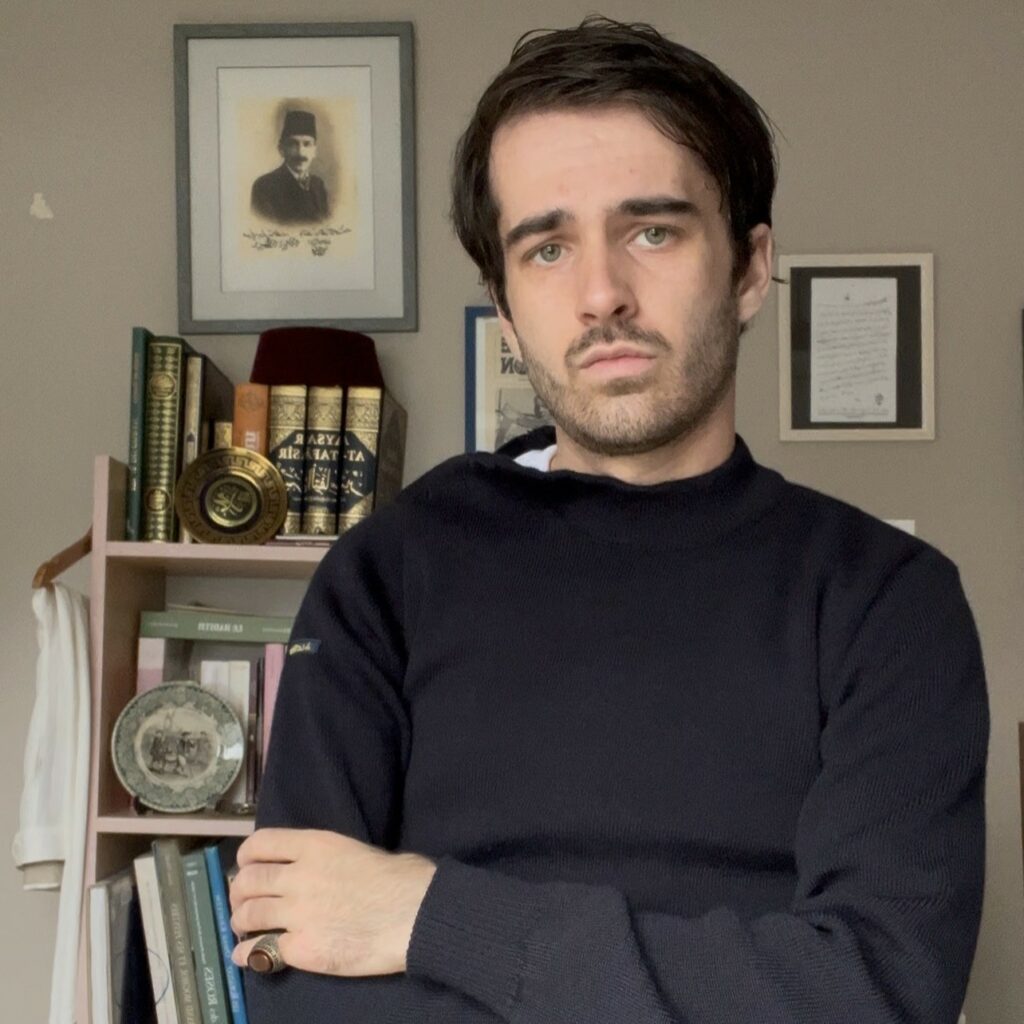
Have you ever been concerned about being perceived as an outsider working with a cultural heritage that is not your own?
At first, no. My attraction to these traditions was simple and sincere, and I did not think much about it.
Over time, however, the question inevitably arose. We live in an era in which this issue is raised almost automatically, sometimes with a certain degree of bad faith. Yet I remain convinced that art has never required a certificate of birth to be legitimate.
What gives me the right to work within these traditions is the seriousness of my research, my respect for the original sources, and the honesty of my approach.
What do you believe contemporary artists can still learn from the great masters of miniature painting?
That craftsmanship exists.
That there are skills which must be learned, transmitted, and cultivated over many years. These artists spent decades mastering their craft before producing anything truly significant.
Today, those stages are often rushed or skipped altogether. We have, to some extent, lost the understanding that before expressing something meaningful, one must first know how to make something well.
Those masters possessed profound technical mastery, yet it never prevented them from being free.
I am not saying there is only one correct path, but in my own case, taking the time to learn before searching for my own voice changed everything.
How do you view the current state of art education in Europe?
With concern.
European art education has largely abandoned the transmission of technical skills in favor of discourse about art. Students are trained to speak about their work—sometimes very well—but far less often to create it with genuine mastery.
There is a growing suspicion toward craftsmanship and technical difficulty, as though competence itself had become questionable.
I am not suggesting a return to rigid academicism, but freedom without a solid foundation strikes me as inherently fragile.
If you could spend a day with one of the great masters of miniature painting from the past, whom would you choose, and what would you ask?
Honestly, I do not know exactly whom I would choose.
What I do know is that I would want to meet the artists behind the Siyah Qalam paintings—those mysterious black-line works that stand apart from everything else produced during their time.
We know almost nothing about them. We do not even truly know the context in which those works were created.
That is what I would want to understand: why they created them, with what intention, and for whom.
Not the technical secrets—simply what was in their minds.
What are your artistic plans for the coming years?
I am preparing an exhibition in Paris for 2027, which will represent an important milestone for me. My goal is to present a coherent body of work, rather than simply a collection of individual pieces.
At the same time, I am working on a book about Islamic art and Suhrawardī’s ʿĀlam al-Mithāl (the Imaginal World), bringing together my pictorial practice with a broader philosophical reflection.
There is also something that increasingly attracts me: illustrating manuscripts and literary texts.
At the moment, I am working with publishers to explore which texts I might illustrate and under what circumstances.
It feels like an entirely natural direction—almost self-evident. The traditions I study were born from the book and have always remained inseparable from it. Returning to them through that medium simply makes sense.
You are currently preparing an exhibition in Paris. What would you like visitors to take away from their encounter with your work?
I would like them to realize that this art is not dead.
It is very much alive in France, sustained by the hands and minds of people who genuinely believe in it.
I do not claim to represent an entire tradition by myself. I am simply one voice among many. But I hope that, in my own modest way, this exhibition will help restore to this art the dignity and recognition it deserves in France.
Finally, what message would you like to share with young artists who are still searching for their own path?
That they have time.
A whole lifetime to create, to exhibit, and to discover who they are as artists.
What they should avoid at all costs is harming themselves by obsessing over what will “work”—strategy, visibility, or the market.
What truly matters is the relationship you cultivate with your art, your inner development, and the honesty of your artistic journey.
If someone with genuine passion recognizes something intimate and sincere in your work, it will succeed.
Perhaps not quickly—but it will.
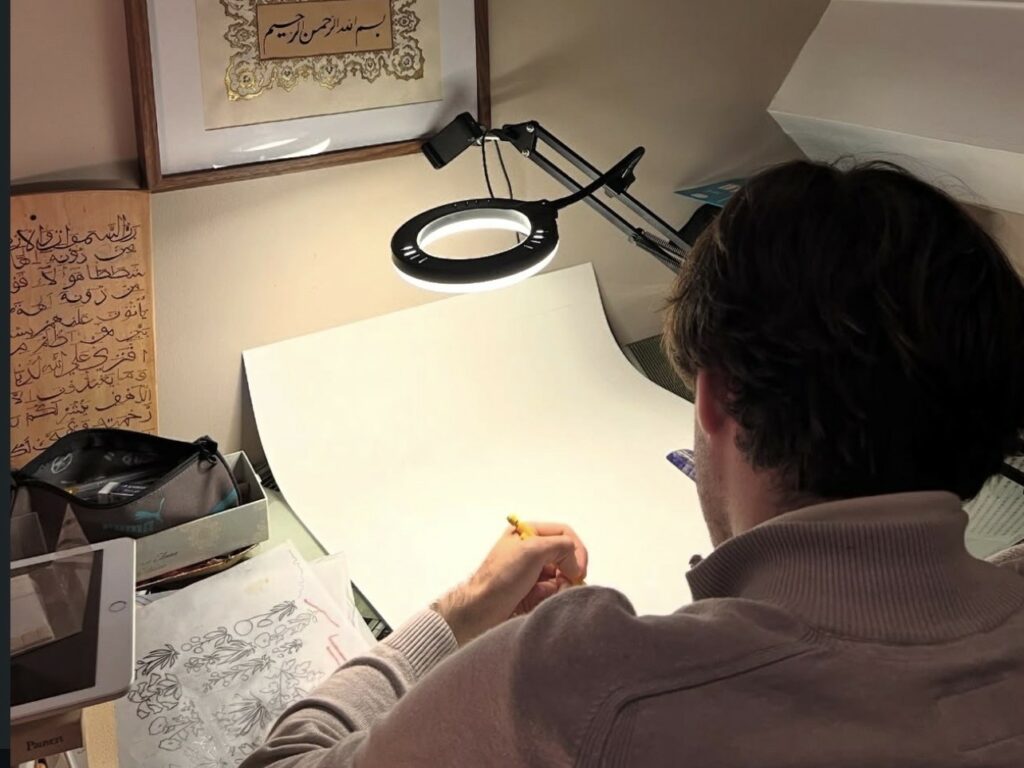
Louis-Ange Maucarré’s artistic journey reminds us that cultural traditions are not static relics preserved behind museum glass, but living legacies capable of inspiring new generations of artists. His work demonstrates that respect for history and the pursuit of originality are not opposing forces; they can exist in harmony, enriching one another through careful study, intellectual curiosity, and artistic sincerity.
Throughout this conversation, one idea emerges consistently: genuine artistic expression requires patience, discipline, and honesty. Whether discussing miniature painting, philosophy, or craftsmanship, Maucarré returns to the same principle—that meaningful art grows from sustained commitment rather than the pursuit of novelty or immediate recognition.
At a time when speed often overshadows depth, his work offers a compelling reminder that the dialogue between past and present remains one of the most fertile paths for contemporary creation. We hope this interview encourages readers not only to discover Louis-Ange Maucarré’s remarkable work, but also to look anew at the enduring beauty and intellectual richness of Persian and Ottoman miniature painting.