
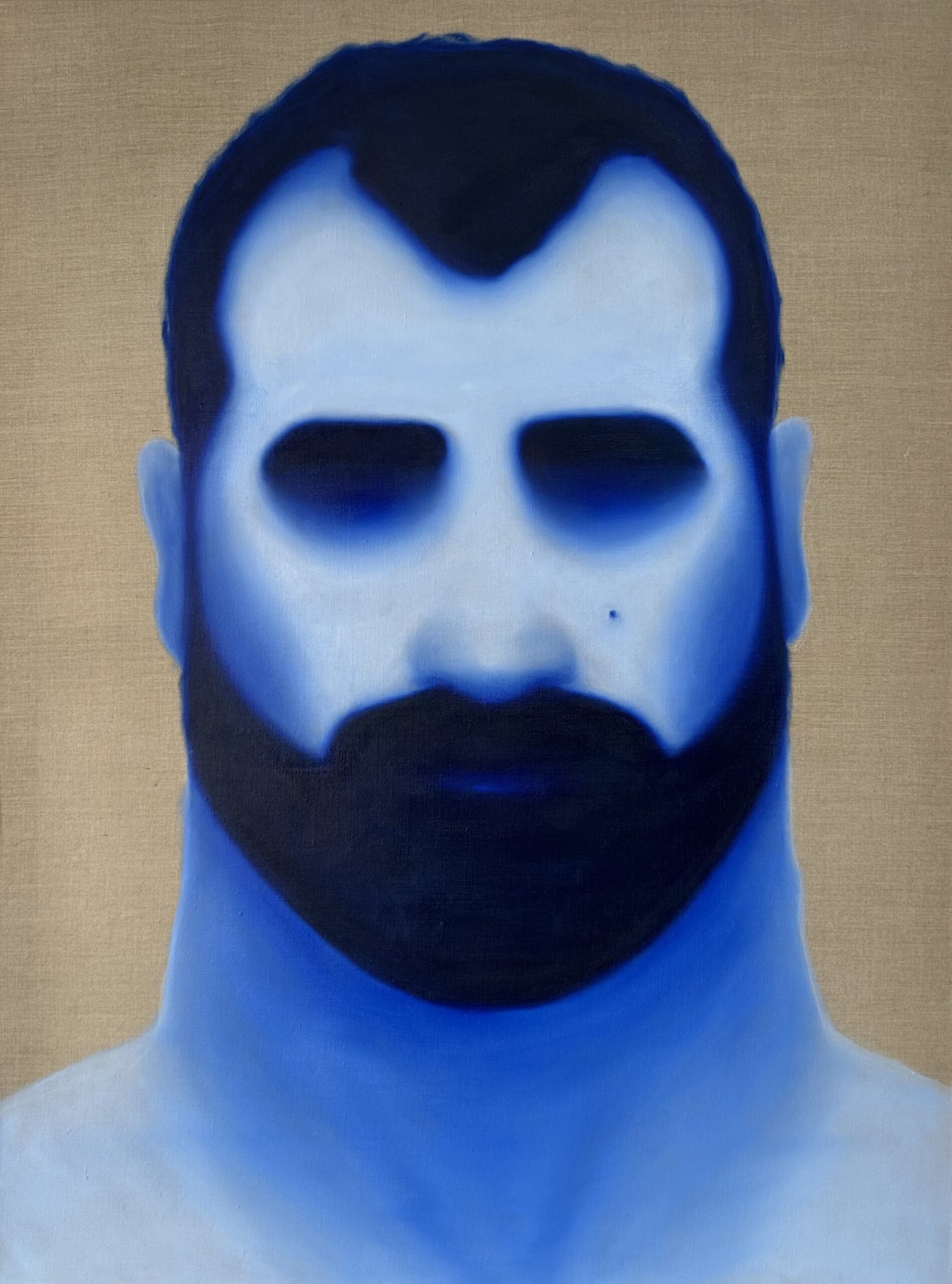
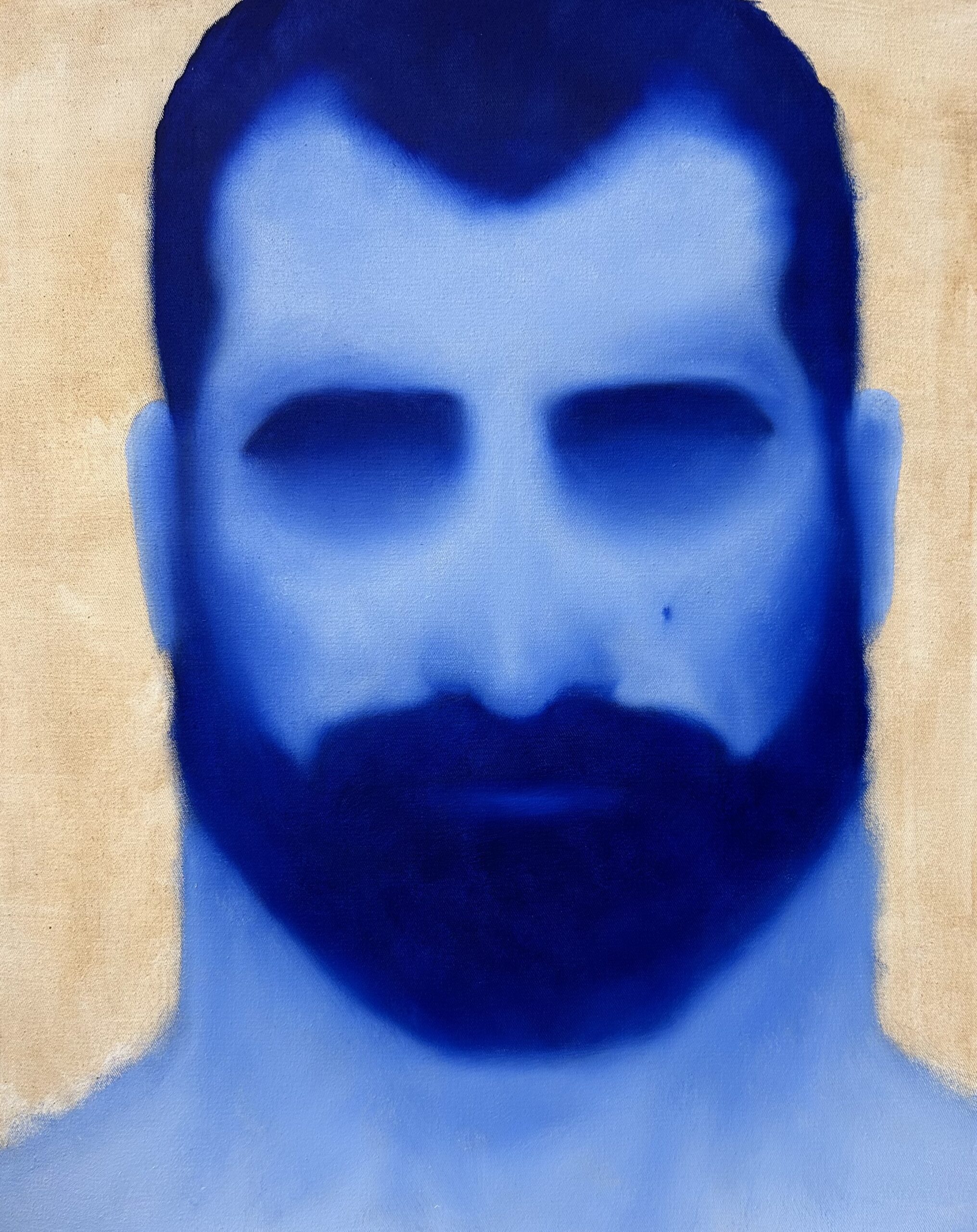
André Teymouri paints from a small set of fragments — a jawline glimpsed on the subway, a beard seen on the street, a stranger’s photo on Instagram — and lets them settle into a face that belongs to no one in particular. The men in his paintings are bearded, broad-shouldered, often shirtless, and almost always the same shade of blue: a colour he traces back to the Persian carpets and blue-and-gold glassware of his childhood home. Working under the name Eybaba, he uses that blue to work against the hypermasculine reading his subjects invite at first glance, opening instead onto something quieter.
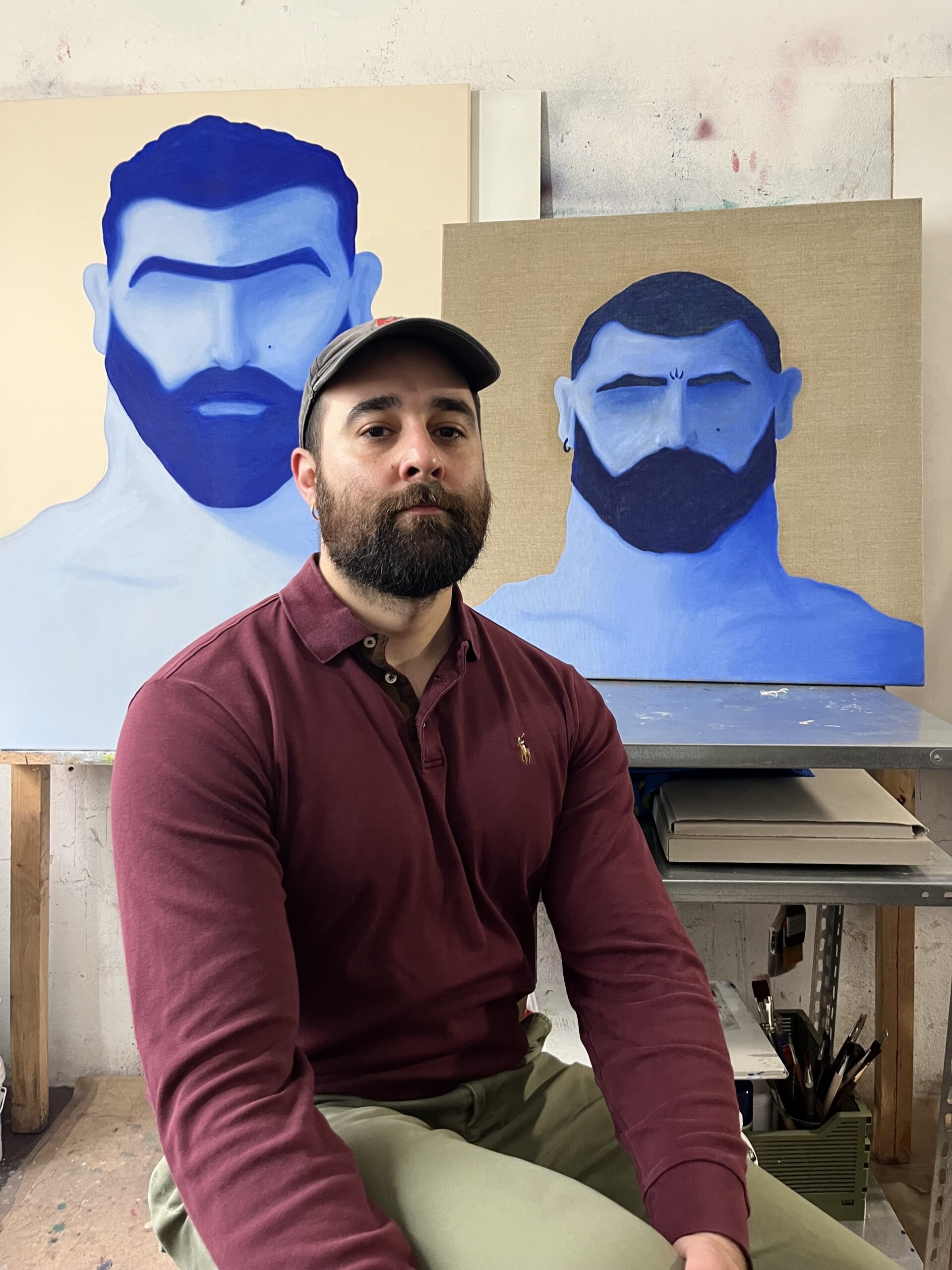
Teymouri was born in Gunzenhausen, Germany, in 1991, to a Persian father and a German mother, and studied landscape architecture at Hochschule Weihenstephan-Triesdorf before turning to painting full time. He is now based in Berlin. His work has been part of Galerie Newman’s collection since this spring and appeared in the group exhibition “Existence” in Hamburg this past summer; TOH! Magazine profiled him, writing that his men “aren’t always tied to the Middle Eastern world.” Several of his portraits — Minoo, Farzad, Crybaba, both untitled canvases from this year — are already marked sold on his own site, and his prints circulate through Kellerkreuzberg in Berlin, HARD STORE in Athens, Juicy Shop in Leipzig, and Odd Kiosk in Barcelona.
We put eight questions to him in writing. His answers are printed below, lightly edited for punctuation and typography only.
You trained in landscape architecture at Hochschule Weihenstephan before painting became your main practice — what pulled you toward portraiture, and does that training still show up in how you compose a canvas?
It all started with a self-portrait. There was something about capturing a person through their face and physical features that immediately felt right to me. My studies and professional experience in landscape architecture don’t necessarily have a direct influence on how I compose my paintings. I wouldn’t say that I consciously apply what I learned there to my work. However, I do think that studying and working in a visual field has shaped the way I observe spaces, forms, proportions, and compositions. So even if the connection isn’t always obvious, I’m sure some of it has found its way into my practice.
Blue runs through nearly every piece — Minoo, Bababoi No. 4, Crybaba. Was there a specific moment you landed on blue as your language, or did it build up piece by piece?
Because of my background, the colour blue was always present in my surroundings while I was growing up. Persian carpets in blue and white, for example, were a big part of my home, as well as blue glasses with gold details that belonged to my grandmother. I think all of these things had a strong influence on me visually and shaped my relationship with the colour blue from an early age. I guess that’s why it eventually became such an important part of my own work.
Your men are often bearded, broad-shouldered, shirtless — read at first glance as classic hypermasculine types, but the blue softens that. Who are they to you — people you know, composites, archetypes?
The men I paint don’t exist as such. They are usually fragments — individual features of men I encounter in everyday life, whether on the subway, on the street, or on Instagram. These are brief moments in which I take note of certain features and hold on to them. Eventually, these fragments come together on the canvas. What I find interesting, though, is that many people I know — friends, acquaintances, or even partners — recognize someone they know in these portraits.
Titles like Bababoi and Crybaba have a playful, almost teasing tone next to how quiet and intense the paintings are. What do these names mean to you, and how do you usually land on a title?
Because my artist alias is eybaba and I started calling all of my portraits “Bababoi” when I first began making them, the idea of incorporating the word “Baba” into my titles naturally came about. In general, the title depends on whether the work belongs to a specific series or not. For example, my larger works often have Persian names. Most of the time, the names also have a meaning behind them. This idea came to me when I realized that, after finishing a painting, I would often sense a certain feeling or presence within the work. I then started looking for a Persian name that could capture and express that particular feeling or presence.
TOH! Magazine wrote that your men “aren’t always tied to the Middle Eastern world.” Do you agree with that reading, or is your Persian heritage more present in the work than viewers might assume?
Good question. I would say sometimes more, sometimes less. But I would say that most of my portraits do have features that are typically associated with men from the Arab or Persian regions — beards, masculine facial features, and body hair.
Your practice is often described as sitting at the intersection of heritage, emotion, and queerness. How present is that last part in the paintings themselves, versus in your life as the person making them?
In the beginning, I would say that my work was much more explicitly homoerotic. Over time, however, I started asking myself whether my work was still queer or gay, and what those labels actually meant in relation to my art. Nowadays, I think it’s really up to the person looking at my work to decide whether they see it as queer, gay, or simply as art. Of course, I am a gay man, and that perspective is inevitably part of who I am as an artist and shapes the work I create. But at the end of the day, I make art. And I think that’s one of the beautiful things about art: everyone brings their own experiences, emotions, and interpretations to it. There doesn’t have to be just one way of seeing or understanding a work.
Within the same body of work you move between oil on linen, acrylic, charcoal, and mixed technique on paper. What does each material let you say that the others can’t?
I love playing with and experimenting with different materials. Each material has its own qualities and can achieve things that the others simply cannot. For me, the process of discovering these qualities is what matters most — understanding how each material behaves, how it interacts with the others, and what kind of aesthetic I can create with it. There is something exciting about not always knowing exactly how a material will respond and allowing that process of experimentation to become part of the work itself.
What’s next — any subject, material, or scale you’re pushing toward that isn’t in this portfolio yet?
I would like to incorporate the male body more into my work and explore it further as a subject.
Afterword
Asked what’s next, Teymouri didn’t point to a new colour or a new city, but to the body itself — he wants to bring the male figure further into the work than the faces and shoulders that have carried it so far. The blue, on his account, was never a strategy; it arrived first, in a grandmother’s glassware and the carpets of a childhood home, long before it became a way of working against a stereotype.
He continues to paint from Berlin, where his portraits move quickly — from canvas to private collections, several of them already sold before this piece went to press.
Read next: Nicole Meeuws on Painting After a Near-Death Experience
André Teymouri paints under the name Eybaba, from Berlin. His work can be seen on Instagram, through Galerie Newman, and at Odd Kiosk.
Interview conducted in writing by Kasra Aliha for Honargardi, September 2026. Artworks reproduced by permission of the artist; copyright André Teymouri.