
Nicole Meeuws had never painted. In 2015, a medical emergency in an Austrian hospital brought her close to death, and she returned with what she describes as vivid memories of somewhere else. Painting followed. It was not a plan.
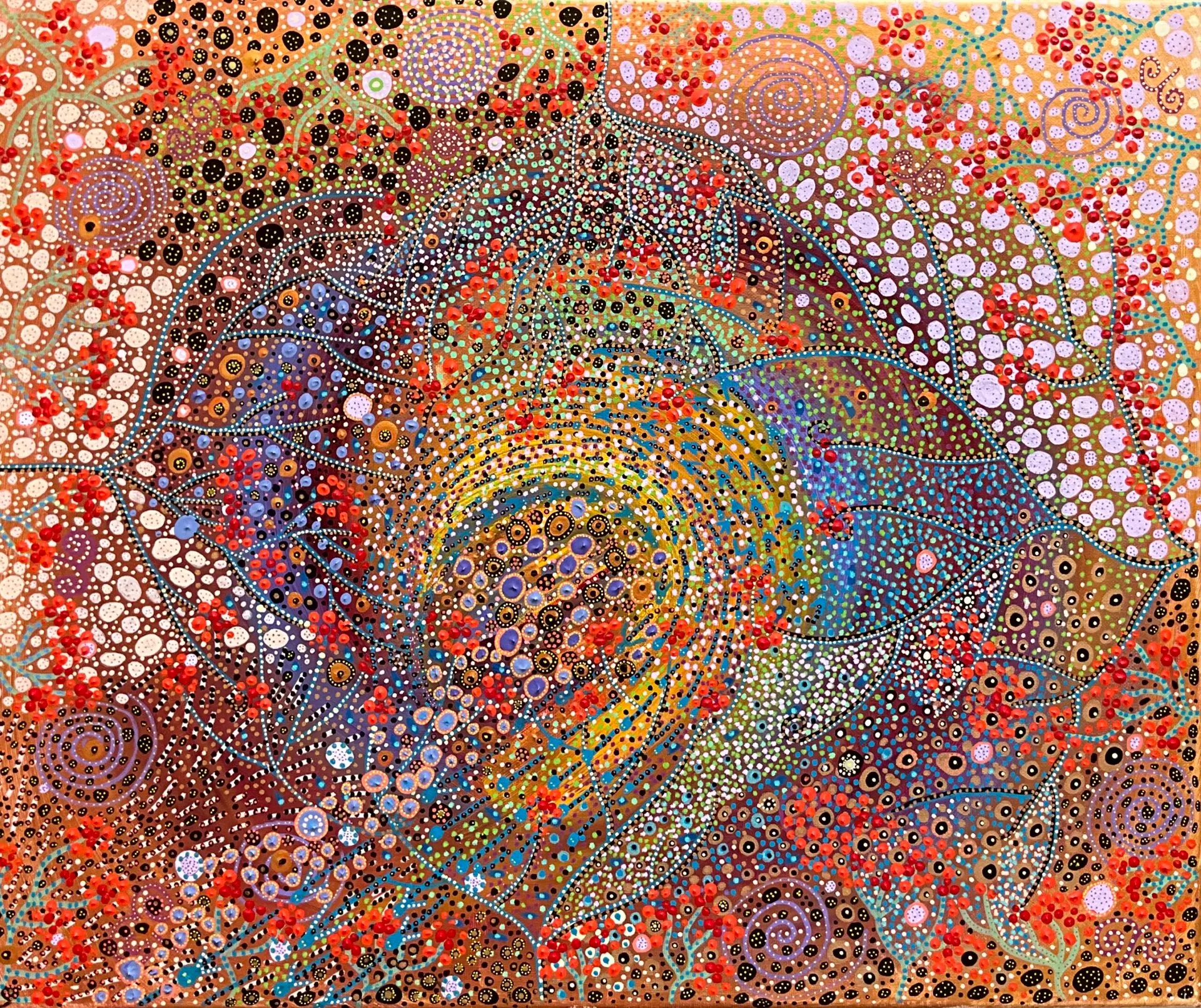
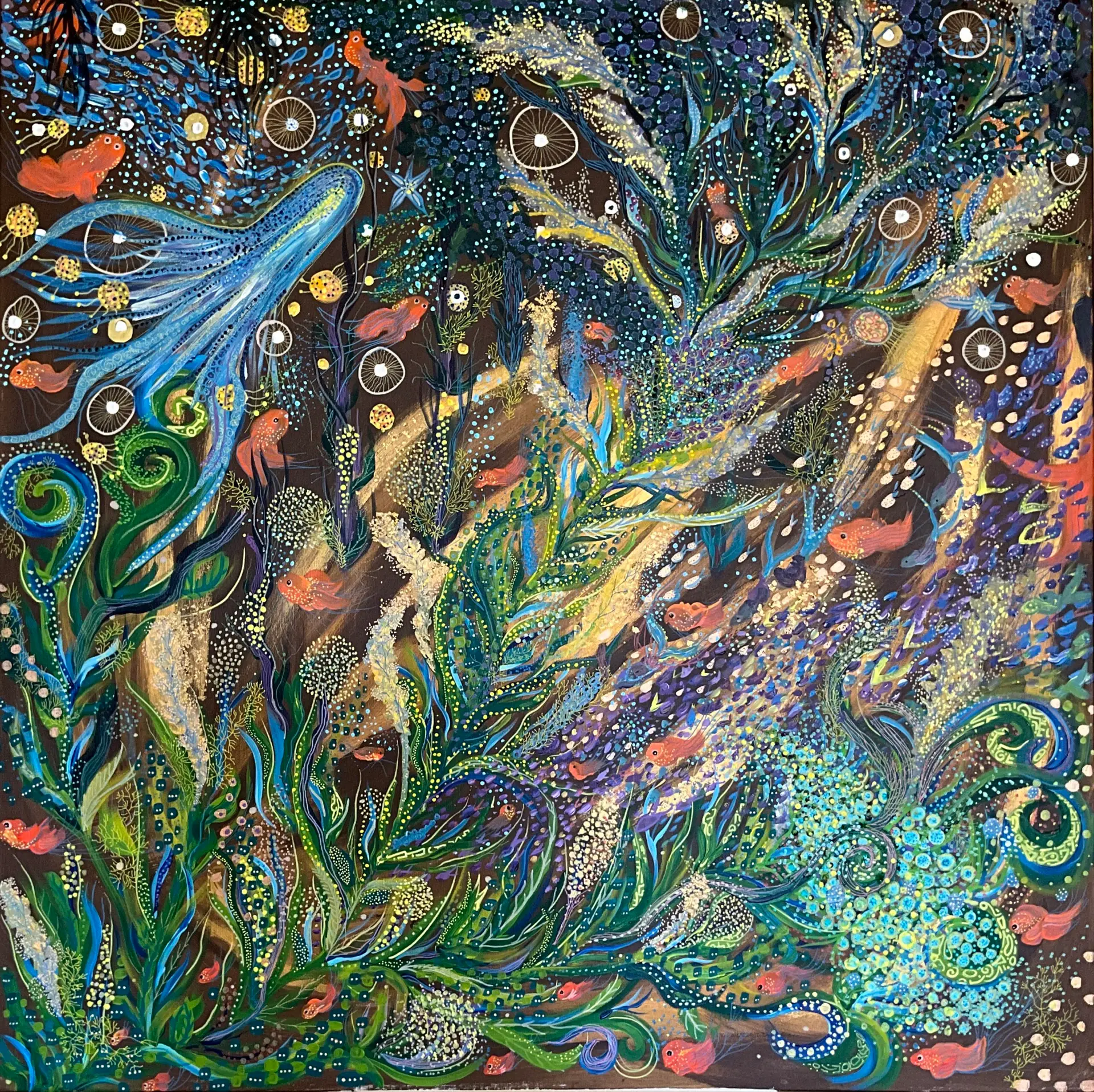
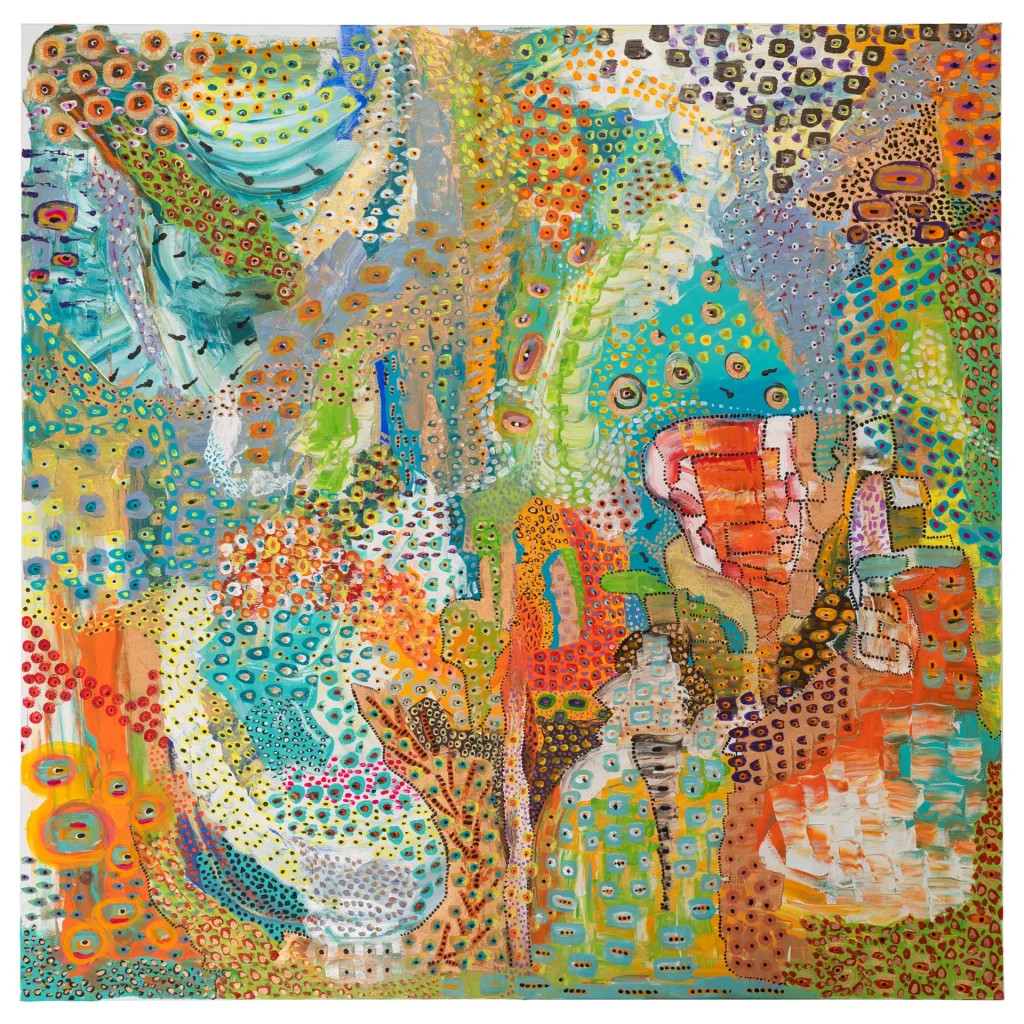
Ten years on, she works from northern Greece, near Drama. The canvases are built dot by dot in acrylic, often square and often large: An Ode to Water, Indigenous, Molecular, SiriusB, Star Knowledge. Recurring through them are hybrid figures, an unfamiliar script, and water. She says she only later found parallels between this imagery and ancient Mesopotamian material she had not studied.
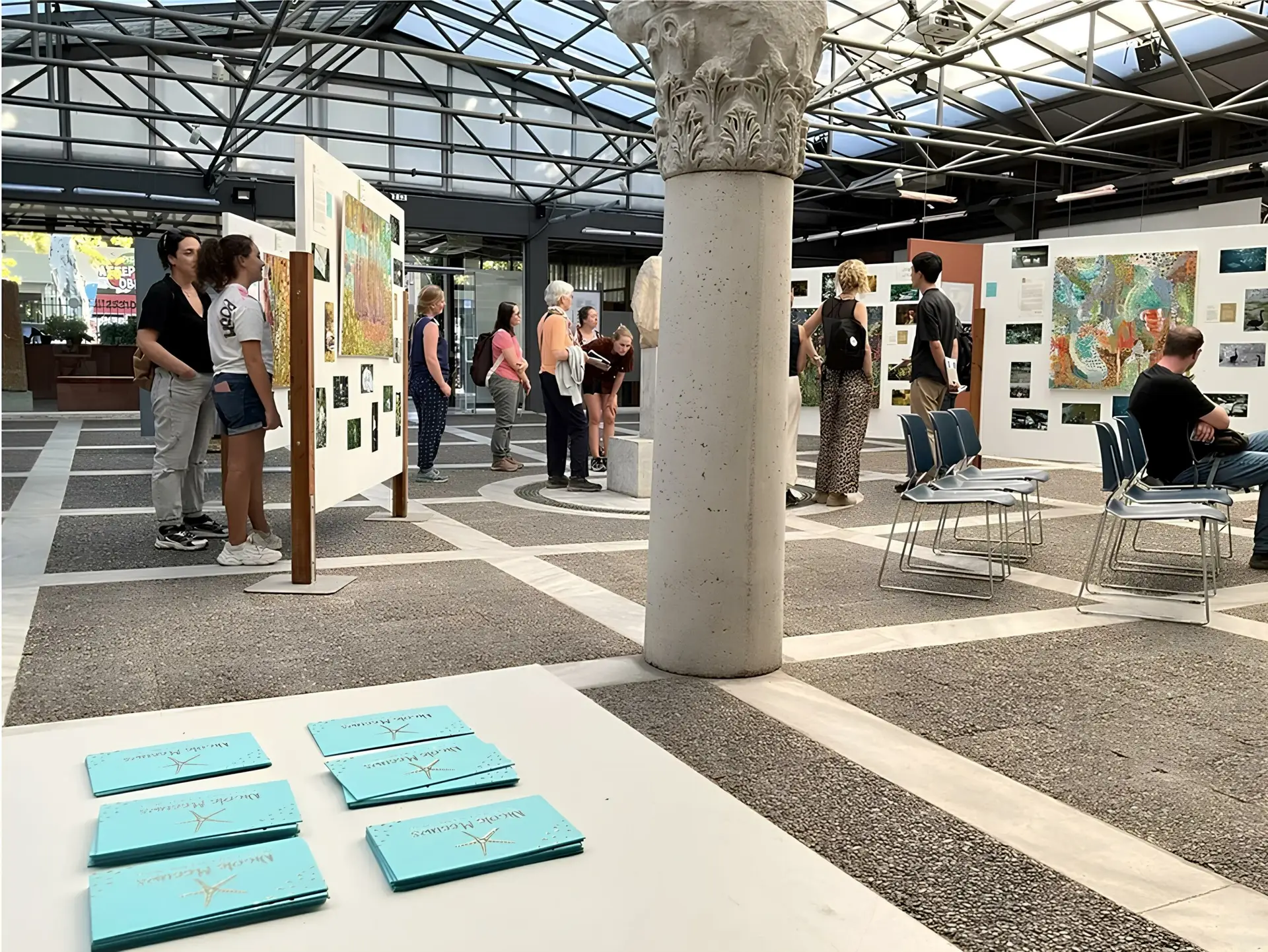
Her exhibition history is short and recent. An Ode to Water in 2024 and Frequency Art in 2025, both on Paros; a group show at The Holy Art in Athens in late 2024; and A Call to Nature at the Archaeological Museum of Drama in September 2025. She is now making a new body of work, undecided on where it will be shown, and developing an immersive extension of her painting through projection and sound.
We put eleven questions to her in writing. Her answers are printed below, lightly edited for punctuation and typography only.
You died during a medical procedure in 2015 and had never painted before. What happened between that day and the first time you picked up a brush — how long was the gap, and what finally started it?
Before my NDE in 2015, I had never painted and had never imagined becoming a painter. Afterwards, I came back with extremely vivid memories and a profound sense that reality was much larger than I had previously understood. I would need to check my records to give you the exact gap before my first painting, but what I remember clearly is that the impulse to create appeared during that period without any plan to become an artist. When I finally picked up a brush, it felt strangely natural. Painting became the place where I could live with the experience without having to explain it, and it gradually became a language for things I could not express in words.
You describe an unknown script appearing in the work. Is it consistent from painting to painting — the same characters recurring — and do you record it outside the canvases? Do you feel you understand it, or only transcribe it?
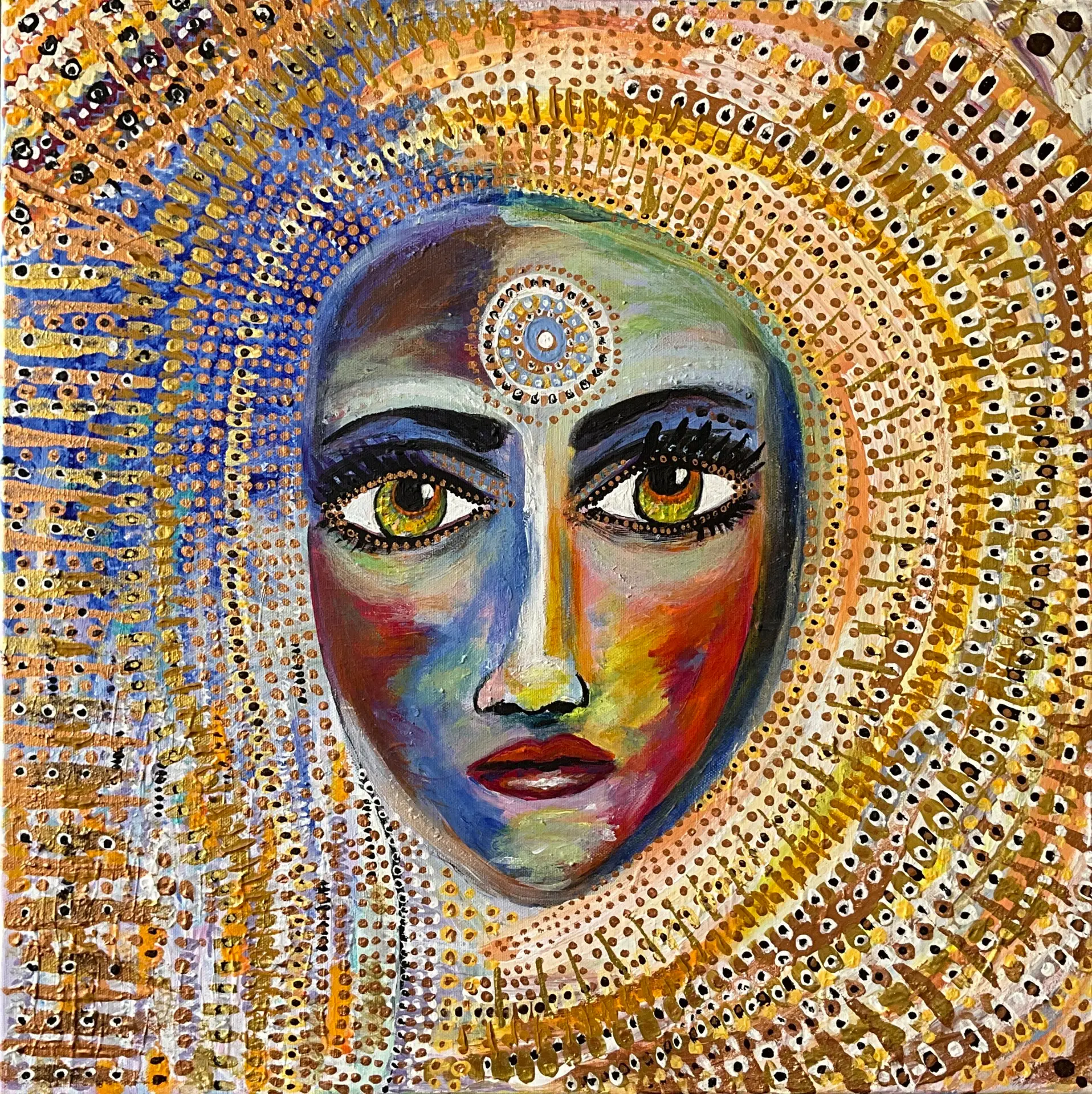
Certain forms and characters recur, although I would not describe it as an identical alphabet appearing in every painting. I rarely invent them consciously; they tend to emerge when I am very quiet and deeply absorbed in the work. I sometimes describe that state as tuning into an information field, although I mean that intuitively rather than scientifically. I have recorded similar symbols outside the canvases because I became curious about what was repeating. I cannot translate the script in a literal sense, although sometimes I feel I understand the emotional or energetic quality of it. “Transcribing” is probably closer to the experience, and the research usually comes afterwards when I begin asking why a particular mark or symbol appeared.
You later found parallels with Mesopotamian imagery. Which images specifically, and how did you come across them? Have you considered the possibility that you encountered them earlier without remembering?
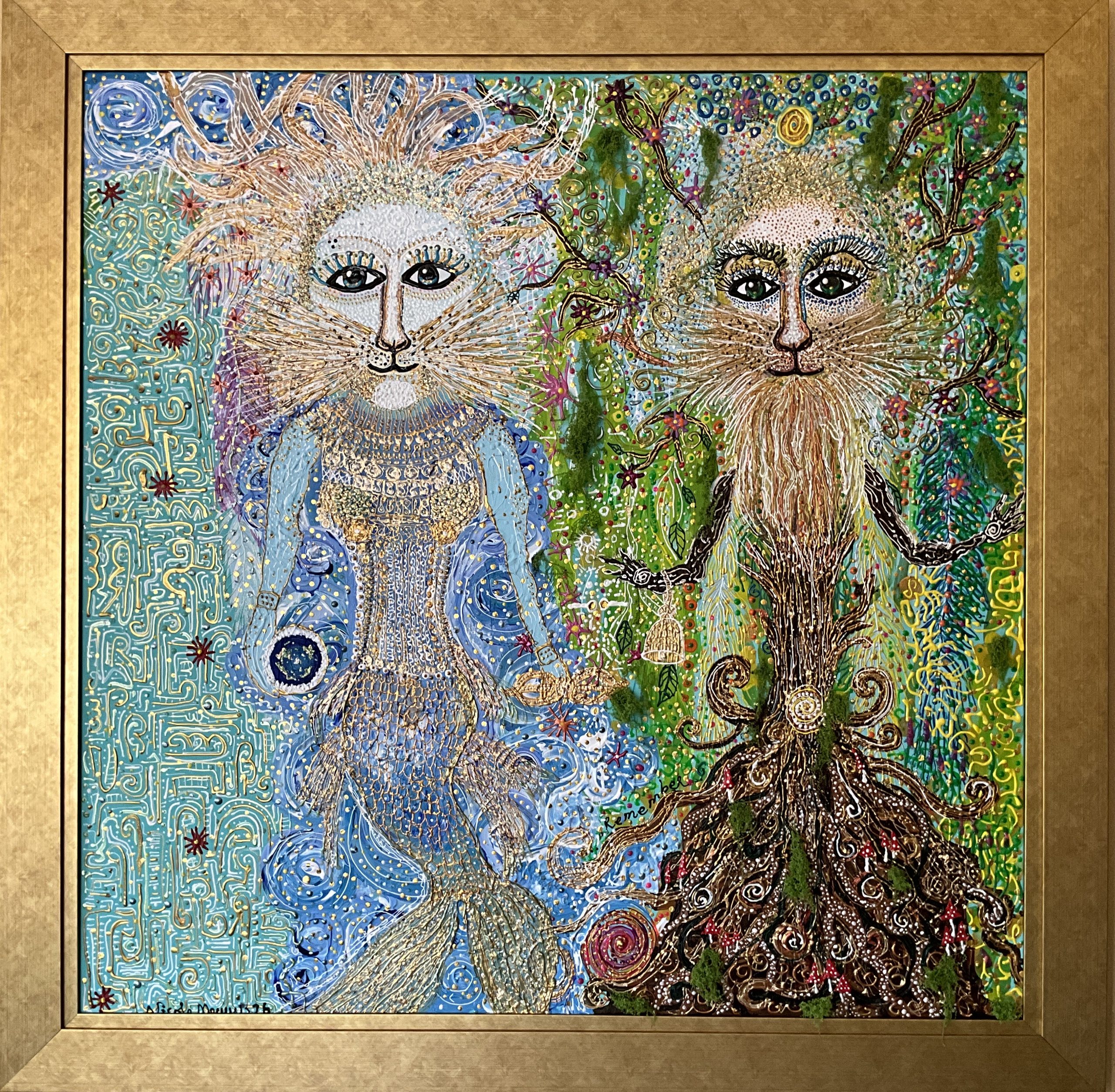
For me, the chronology is very clear: the NDE came first, the painting came second, and the research came afterwards. During the NDE I encountered two separate, androgynous beings seated on what I perceived as thrones, with pale humanoid upper bodies, aquatic or fish-like lower bodies, intense indigo eyes and unusual feather-like hair. After the NDE, related hybrid forms and symbols began appearing in my paintings. I had not consciously seen or studied Mesopotamian imagery before this, had no familiarity with it and no memory of encountering these forms. I only later came across Mesopotamian and Babylonian material, including imagery associated with the Apkallu and other hybrid human and aquatic beings, through my own research. I have considered unconscious memory because it is a reasonable question, but my own experience remains that the imagery came first. I do not present the historical parallels as proof; I find the sequence itself — experience, painting, discovery — more interesting than forcing an explanation.
Titles like SiriusB, Star Knowledge, Egyptopia and Indigenous draw on specific cultures and cosmologies, and your Instagram handle references the Dogon. How do you think about the line between resonance with another culture’s sacred imagery and borrowing from it?
I respect that every culture carries its own history, sacred meanings and context, and I would never deliberately take something sacred, remove it from that context and present it as my own. At the same time, I do not experience humanity as fundamentally divided. I see culture as both specific and permeable: traditions deserve respect, but human beings across very different civilisations have repeatedly asked the same questions about birth, death, consciousness, nature, the cosmos and the unseen. My spiritual understanding is that consciousness may not be limited to one lifetime or one cultural identity, so profound resonance can sometimes feel more like recognition than ownership. In my own work, the image usually comes first and the cultural connection comes through later research. I try to hold both ideas at once: cultural specificity matters deeply, and yet at the deepest level we remain one human family.
You build up surfaces dot by dot, and work with brushes, hands and natural tools. How does a painting begin — with an image, a colour, a feeling — and how do you know when one is finished?
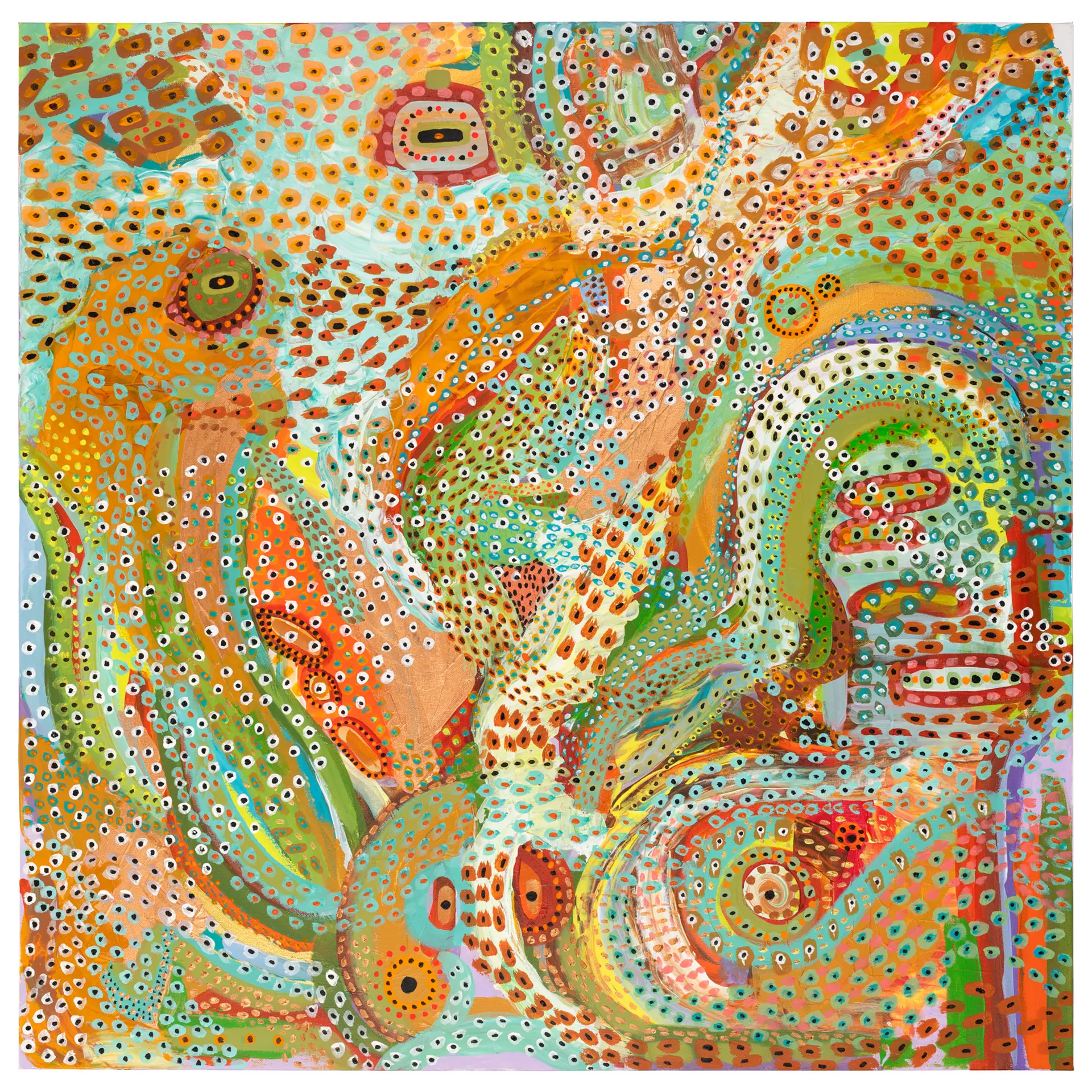
A painting usually begins with a feeling rather than a complete image, sometimes a colour, movement, atmosphere or the impression of a being or landscape. I work intuitively with brushes, my hands and sometimes natural or improvised tools, building the surface slowly through layers, dots and repeated marks. Silence is important because when I stop imposing too much intention, unexpected imagery can emerge; for me, creativity becomes a form of listening. Knowing when a work is finished is equally intuitive. Eventually the painting becomes quiet and stops asking me for anything. If I continue beyond that point, I can disturb the balance, so finishing is partly about knowing when to stop interfering.
Water runs through the work: An Ode to Water, Coral Reef, Oceans of Memory. Why water?
Water is one of the deepest recurring elements in my work. It is biologically inseparable from life — we begin in the fluid environment of the womb and remain dependent on water throughout our lives — but for me it also carries a profound spiritual significance because the realm I experienced during my NDE had an aquatic quality and the beings I encountered were themselves partly aquatic. Everything about that experience felt ancient and sacred, almost as if water carried an old form of knowing. I sometimes imagine water metaphorically as a natural archive, moving through bodies, oceans, atmosphere and generations. Human cultures have blessed it, baptised in it, prayed over it and built civilisations around it for millennia. I increasingly feel that my work is also asking us to remember that water is not merely a resource: it is life, memory, threshold and something worthy of reverence and protection.
Your Soul Frequency Paintings are made for a specific person, from a photograph. Does painting on commission change what appears on the canvas, compared to when you paint for no one?
Yes, because the person becomes an anchor, although the process remains highly intuitive. I begin with a photograph but I am not creating a conventional portrait; I allow colours, symbols, textures and forms to develop around what I sense from the person. With every Soul Frequency painting I also send a descriptive letter explaining the symbols and impressions that appeared and how I felt they related to the client’s life or inner world. I have created these paintings for hundreds of clients internationally, and the feedback has been remarkably consistent: people frequently tell me that the interpretation relates closely to experiences or circumstances I could not have known from the photograph alone. I do not present that as a scientific measurement of a “soul frequency,” but after seeing that recognition repeatedly over many years, I trust the process deeply.
In September 2025 you showed A Call to Nature at the Archaeological Museum in Drama — contemporary visionary painting inside a museum of antiquity. What did that setting do to the work?
The setting created a powerful dialogue across time. The paintings were no longer isolated within a neutral gallery space; they were surrounded by objects made by people who also used symbols, animals, ritual forms and images of nature to approach things that cannot always be expressed literally. I would never say the museum context “proved” any connection between my work and antiquity, but it made the temporal boundaries feel less rigid. Contemporary intuition and ancient material culture remained completely distinct, yet they were allowed to speak to one another through the shared human impulse to give form to mystery.
The new immersive direction turns painted surfaces into moving environments through projection, animation and sound. What does the work gain there, and what does a hand-painted surface risk losing? Are you working with collaborators on the technical side?
The immersive direction began from looking closely at the paintings and realising that they already contain tiny worlds of symbols, light, texture and suggested movement. Projection, restrained animation, dimensional layering and spatial sound could allow a viewer to enter those worlds rather than simply stand in front of them. The risk is that technology becomes spectacle and overwhelms the handmade surface, which contains touch, material, accidents and evidence of the body making it. So the physical painting must remain the source and authority; technology should reveal what is already latent within it rather than replace it. I am currently looking for the right technical and creative collaborators for the first prototype because projection mapping, spatial sound and the technical architecture require specialist expertise.
Your husband had an NDE too, and is both a radiologist and a musician. Has his clinical perspective ever challenged the way you read your own experience?
Yes, and that is part of what makes our conversations so interesting. As a specialist radiologist, my husband is grounded in anatomy, physiology, imaging and medicine, so he is capable of approaching extraordinary experiences through a clinical lens; at the same time, he has had an NDE himself. That means neither of us has to convince the other that the experience felt completely real, but we can still discuss physiological explanations and the limits of current knowledge. I am comfortable saying that I do not know exactly what happened to me. I know what I experienced and how profoundly it changed my life, but interpretation is another question. I do not think science and mystery necessarily cancel each other out; sometimes the most interesting territory begins where our explanations reach their limit.
You work under your own name, Nicole Meeuws. How important is it to you that your art remains closely connected to your personal story and identity?
Very important. My work is deeply personal and grew directly out of experiences that changed the course of my life. I want to present it simply and authentically under my own name, Nicole Meeuws. The paintings, the questions behind them, and the journey that led me to create them are all part of the same story.
Afterword
Asked what connects all of it, Meeuws returned to a single thread: the possibility that we are far more connected — to one another, to nature, to water, to memory and perhaps to realities beyond ordinary perception — than we normally allow ourselves to imagine. Painting, she says, is how she keeps asking the question.
Her next body of work is still in progress, and the venue undecided. Paris is among the cities she is considering, and the one she would most like to see host the first presentation of the immersive work.
Read next: Interview with Hélène: The Story Behind The Red Necklace of the Naked Queens
Nicole Meeuws works in northern Greece. Her paintings, writing and Soul Frequency commissions can be seen at nicolemeeuws.com.
Interview conducted in writing by Kasra Aliha for Honargardi, August 2026. Artworks reproduced by permission of the artist; copyright Nicole Meeuws.