
On 26 October 2026, Room IV at UNESCO in Paris hosted Artists at Risk: Voices That Cannot Be Silenced, a 90-minute session organised by the Permanent Representation of Ireland to the OECD and UNESCO and the Embassy of Ireland. Three artists living in exile — Kubra Khademi from Afghanistan, Mohammed Al Qudwa from Palestine and Mayada Adil from Sudan — spoke with the Irish journalist and broadcaster Dearbhail McDonald about censorship, displacement and what artists need once they have reached safety.
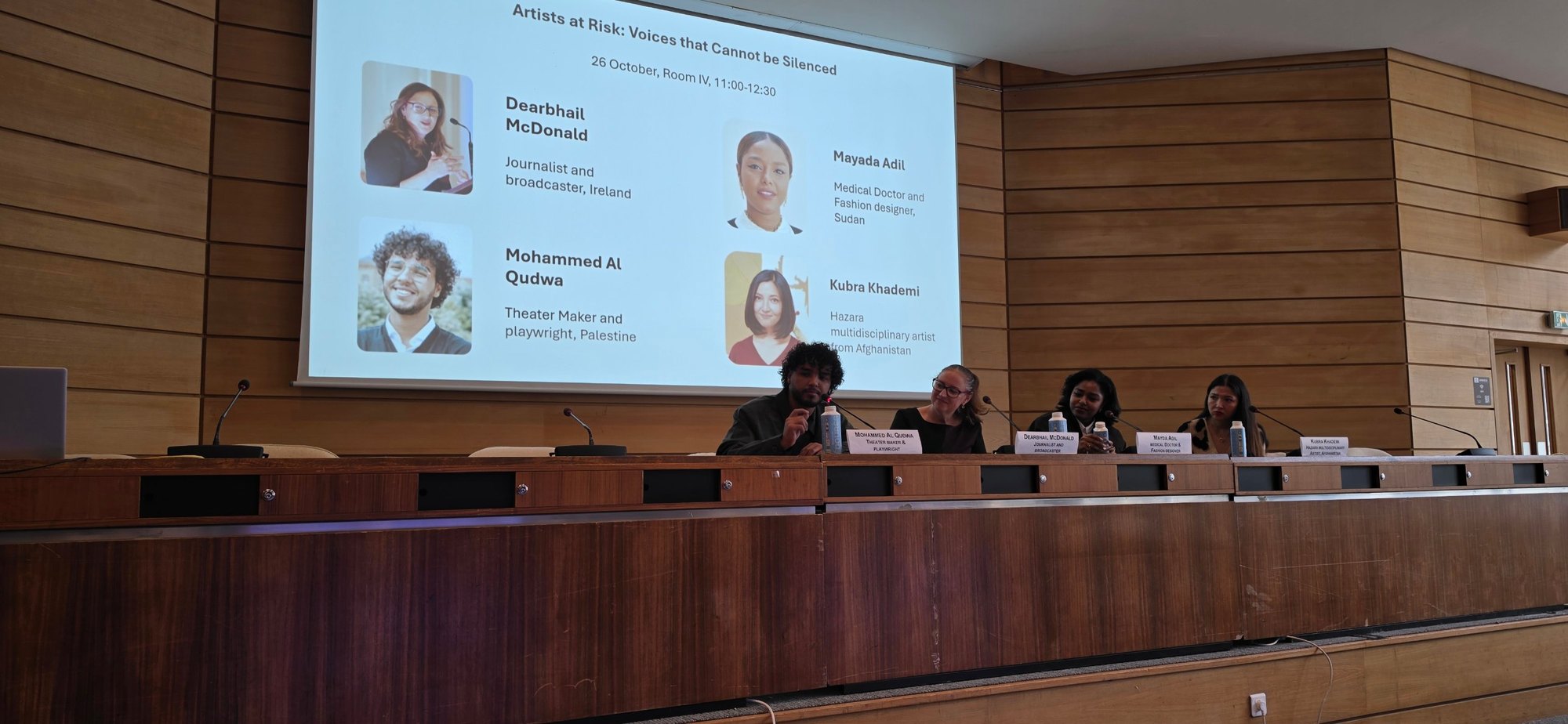
Opening: Investing in Artists
Ireland’s Permanent Representative to UNESCO, Ambassador David Brück, opened the session by saying that Ireland sees support for artists as an investment in democracy, diversity and social cohesion, and he pointed to the country’s Basic Income for the Arts scheme. Elsewhere, he said, artists face censorship, intimidation, displacement and persecution; when they are silenced, what comes under attack is not creativity alone but freedom of expression, critical debate and the diversity of voices on which open societies depend.
Rosario Soraide, Coordinator of the UNESCO-Aschberg Programme for Artists and Cultural Professionals, recalled the 1980 Recommendation concerning the Status of the Artist and the 2005 Convention on the Diversity of Cultural Expressions. According to the remarks, the programme, funded by Norway since 2017, has supported initiatives in more than fifty countries, including recent projects for artists in Afghanistan, Lebanon, Palestine, Sudan, Ukraine and Yemen, among them a creative hub in Port Sudan for displaced artists. “Artists should never have to choose between their safety and the right to create,” Soraide said.
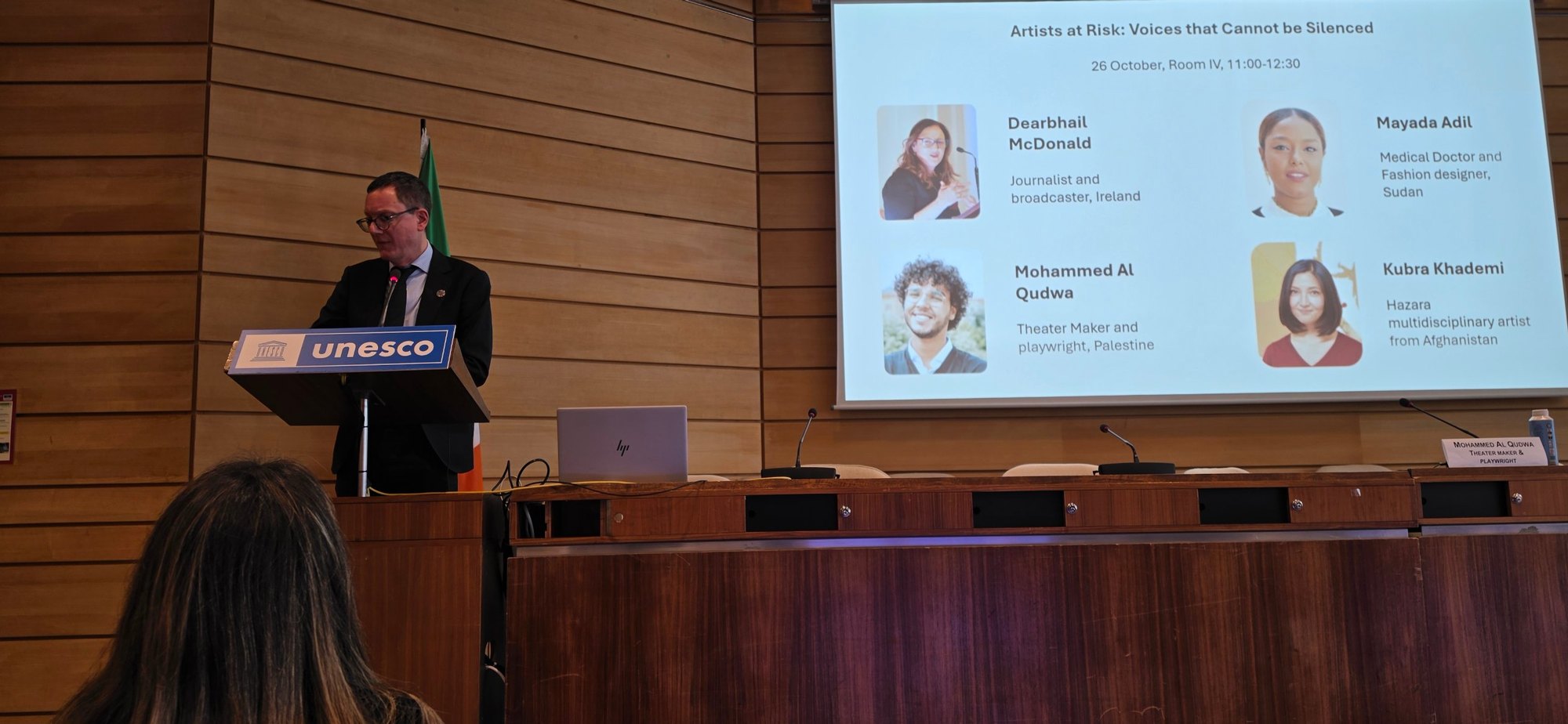
As moderator, McDonald noted that this year’s State of Artistic Freedom report from Freemuse names armed conflict and democratic decline as twin crises for artists, with Gaza, Sudan, Ukraine, Myanmar, Lebanon and Iran among the places affected. She also described Ireland’s own supports for artists: a tax exemption on artists’ earnings since 1969, the state-supported Aosdána academy since 1981, and Basic Income for the Arts, through which 2,000 artists receive €325 a week for three years.
Three Works, Three Kinds of Risk
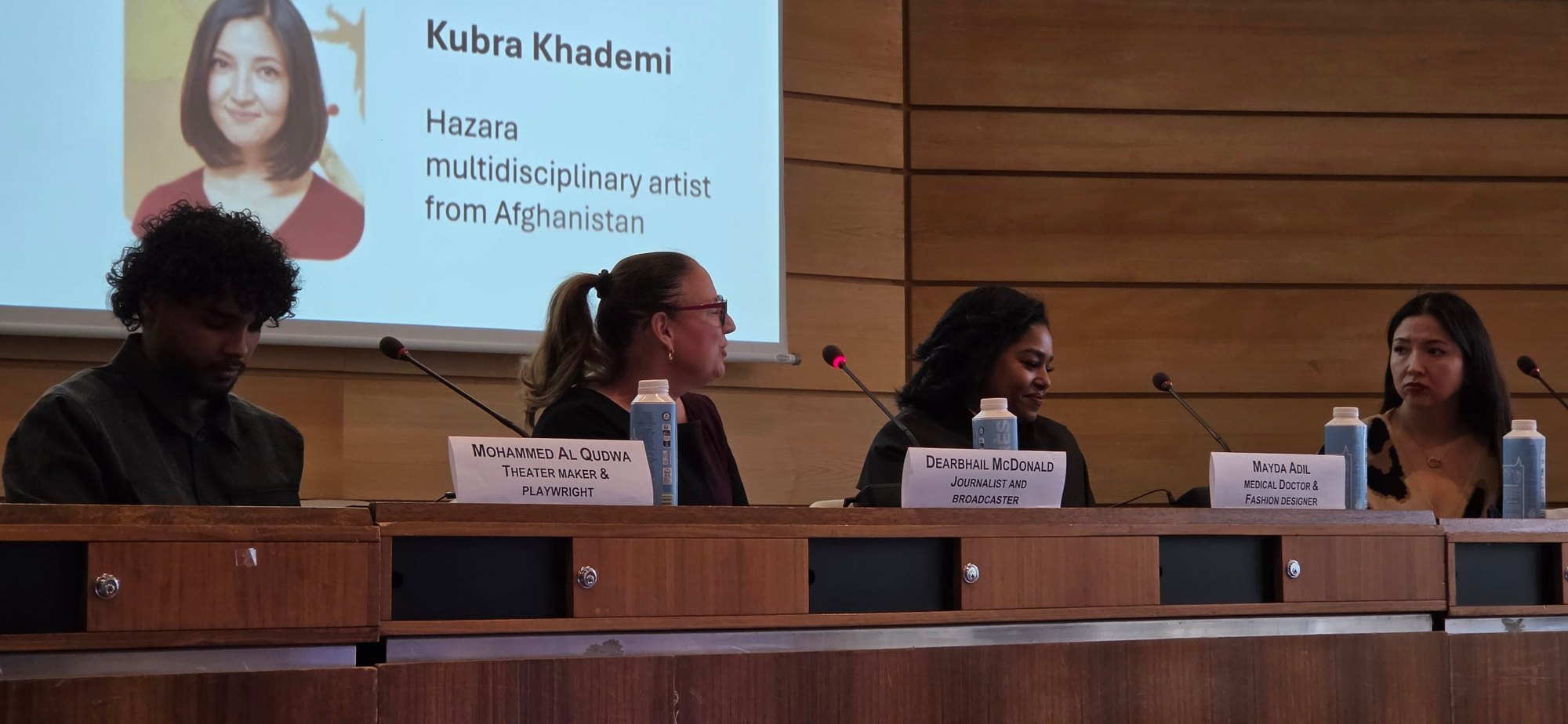
Kubra Khademi, introduced on the panel slide as a Hazara multidisciplinary artist from Afghanistan, was asked to connect two works made years apart: Armor, her 2015 street performance in Kabul, and a later work shown in Paris. According to published accounts, the threats that followed Armor forced her to leave Afghanistan. She recalled the anger her work provoked, said she accepted being rescued, and added that an artwork remains a statement that can be understood beyond any border. Asked about risk, she said she does not think in those terms when she works: “it is how art functions”, she said, in the words of the recording.
Speaking about the present, Khademi said Afghanistan is the only country where women are barred from school and university, and that the world’s silence is part of the tragedy. She described writing letters to prominent women leaders that went unanswered, and turning that experience into a painting.
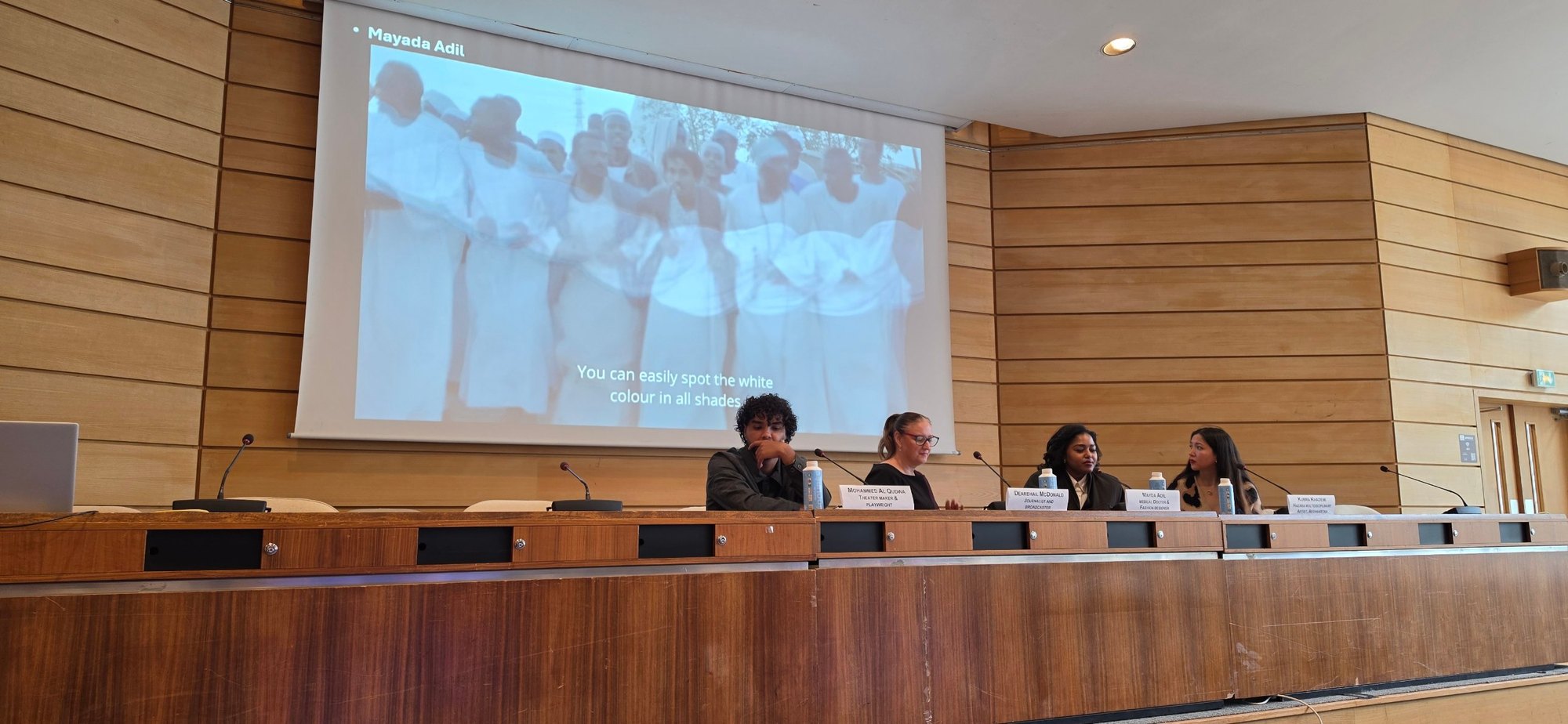
Mayada Adil, a Sudanese physician turned fashion designer who lives in Paris, showed a short film made with Google Arts & Culture about white, the base of her collections. She described it as a colour of Sudanese resilience and peace, worn by women who led the 2019 revolution, and said she chose it to show Sudan’s people as something other than the war that has dominated the news since April 2023. She traced one of her collections, shown at UNESCO’s Africa reception in Paris in 2018, to women she met in a refugee camp while working as a doctor, and said that fashion “took me to the Élysée Palace”.
Mohammed Al Qudwa, a Palestinian playwright and theatre maker, presented an extract from a work in progress called Root, built on the way Arabic words return to three-letter roots — his own name, Mohammed, and Ahmed share one — and on what happens to words when they cross into other languages. He questioned the label “artists at risk” itself, comparing it to expressions such as “Middle East” that remain in use as political vocabulary. He also spoke about Marakeb, a platform created with artists from Gaza so that their work can be known, and said that what he carried with him was responsibility rather than hope. His views on the political situation in Palestine are his own and are reported here as he stated them.
What Artists Need
Asked what concrete help the people in the room could offer, Khademi called for a worldwide connection among artists and institutions. Al Qudwa answered: “We need time” — time, he explained, that depends on affordable materials and on being able to create without having to save everything in the immediate moment. Adil listed psychological support, access to markets, help with temporary visas, recognition of art as a profession rather than a hobby, and inclusive policies; what matters most, she said, is a sense of belonging.
From the Floor
During the questions, a member of the Palestinian delegation, who is herself an artist from Gaza, asked the panel whether they live with survivor’s guilt. Khademi said she feels both lucky and guilty to be alive; Al Qudwa said that art is his therapy; Adil said grief takes time and should be given all the time it needs. An Iranian attendee said that for Iranians time means being alive or not, and that letting artists be heard is the most valuable thing the room can do. An Irish author and another artist also spoke, the latter about how hard it is for artists, women in particular, to ask for funding. McDonald added that a pilot study preceding Basic Income for the Arts compared recipients with non-recipients and found a difference in their well-being and ability to create.
Closing the session, Ambassador Brück named three things he took away: the bravery of the artists, the responsibility that comes with speaking for a community, and a curious optimism. “Hope is an action,” he said.
Event Details
Date and time: 26 October 2026, 11:00–12:30
Venue: UNESCO, Room IV, Paris
Organisers: Permanent Representation of Ireland to the OECD and UNESCO; Embassy of Ireland
Speakers: Ambassador David Brück; Rosario Soraide; Kubra Khademi; Mohammed Al Qudwa; Mayada Adil; moderator Dearbhail McDonald
Text and photographs: Kasra Aliha and Behnood Massoumi. Quotations are taken from the session recording and the official programme; statements are the speakers’ own views.