
Nearly eighteen years after the earthquake of 6 April 2009 brought down its central crossing, the Cathedral of Santi Massimo e Giorgio in L’Aquila has been presented to the city restored. Italy’s Minister of Culture, Alessandro Giuli, spoke on 17 November 2026 at the ceremony marking the conclusion of the restoration works, and the ministry said the cathedral will be handed back to the city at Christmas. According to Archbishop Antonio D’Angelo, it will reopen for worship on 20 December, with a rite of dedication presided over by Cardinal Pietro Parolin, the Vatican Secretary of State.
The cathedral is the religious and symbolic heart of the city, and its return falls in the year L’Aquila holds the title of Italian Capital of Culture. Regional press describes the work as one of the most important restoration sites of the post-earthquake reconstruction. According to L’Aquila Blog and AbruzzoWeb, the works cost more than 36 million euros; AbruzzoWeb specifies that the money came from the Piano Sviluppo e Coesione and from the Fondo Sviluppo e Coesione earmarked for the protection of cultural heritage.
What the 2009 earthquake destroyed
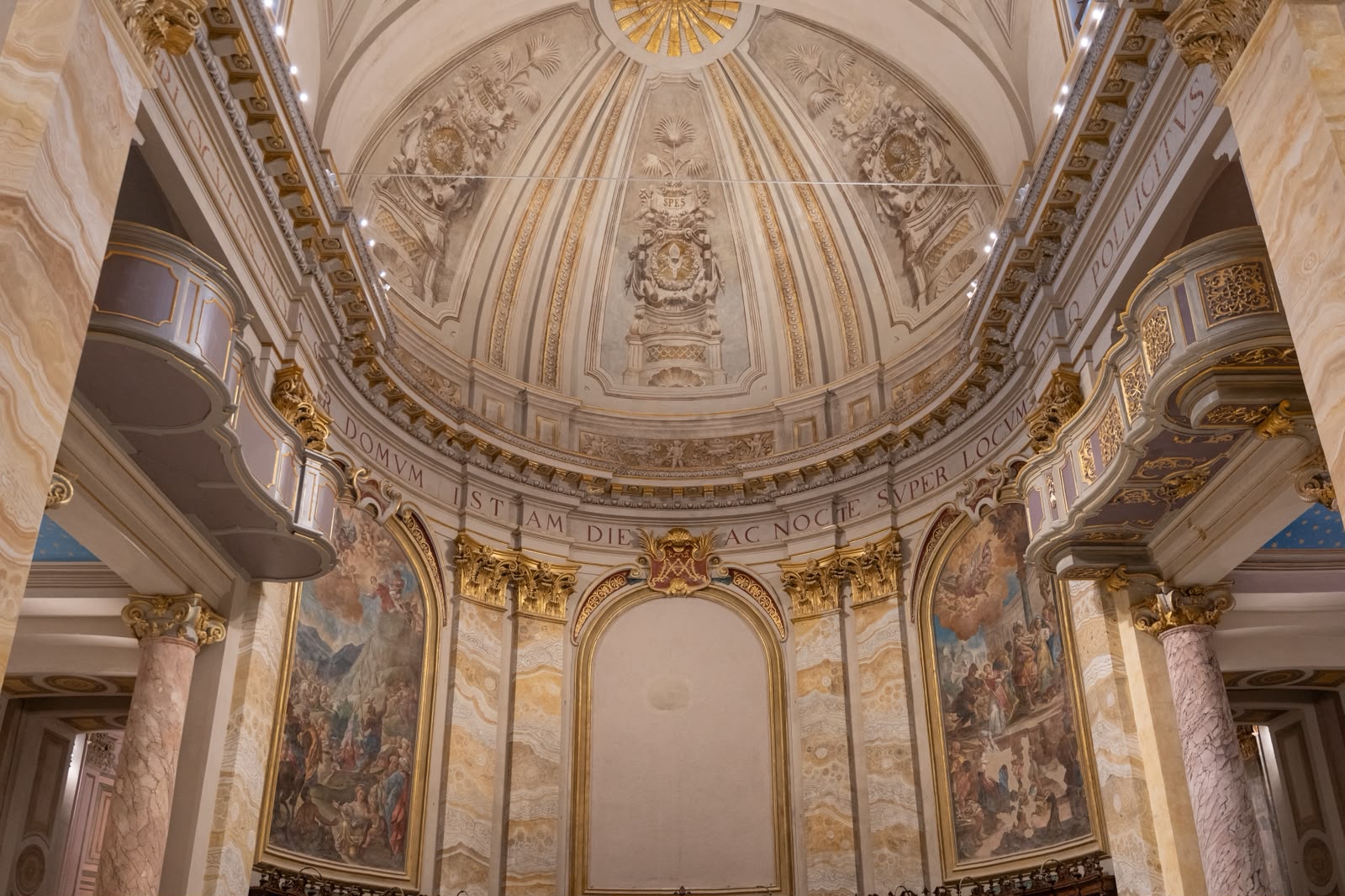
According to a note by the contractor, COBAR S.p.A., published by AbruzzoWeb, the earthquake brought down the crossing, the central point of the church, together with the wall of the left transept. The Altar of the Lombardi, the large canvas painted by Venanzio Mascitelli as a false dome over the crossing, and most of the works around the apse were almost entirely lost.
The building had been shaped by earthquakes long before 2009. AbruzzoWeb recalls that Pope Alexander IV moved the episcopal see from Forcona to L’Aquila in 1257, that the earthquake of 1703 destroyed almost the entire church, leaving only the wall on Via Roio standing, and that the reconstruction, begun in 1711 with Sebastiano Cipriani, ended with the church’s inauguration in 1780. The neoclassical facade dates from the nineteenth century and the bell towers from 1928. The cathedral was entered on the list of national monuments in 1902.
Rebuilding as before, with hidden reinforcement
The works, carried out under the direction of the Ministry of Culture in collaboration with the Archdiocese of L’Aquila, were awarded by public tender to COBAR, a company based in Altamura, in the province of Bari, that specialises in the restoration of cultural heritage. They began in 2023 in two lots, handed over on 27 February and 2 October 2023. The collapsed crossing and left transept wall were rebuilt, and the roofs, the facade, the side on Via Roio, the decorative apparatus, the altars, the wooden elements and the floors were restored.
The COBAR note describes an approach that holds two requirements together: rebuilding the collapsed parts safely while preserving as much of the historic fabric as possible. The new masonry alternates regular stone blocks with courses of brick, matching the historic texture, while bands of steel-fibre reinforcement run inside the walls and vertical steel bars were inserted into their core, so that the reinforcement works inside without changing the building’s appearance. The piers of the crossing were anchored deep with steel bars so that they can also withstand the vertical shocks typical of the L’Aquila area, and the collapsed vaults were rebuilt with bricks laid on edge, as originally.
The false dome is, for now, a reconstruction rather than a recovery. Mascitelli’s composition has been reassembled on a lightweight, self-supporting structure carrying a photographic reproduction of the original canvas, a temporary solution that, according to the same note, leaves time to restore the original painting.
A ceremony, and work still to finish
In the ministry’s statement, Giuli described the restoration as a mission that the authorities consider accomplished, the result of cooperation between religious and civil authorities, and said the cathedral was once again one of the symbolic places of the city’s identity. The same day, he spoke at the inauguration of L’Aquila’s Teatro Comunale “Nazzareno De Angelis”, which the ministry said had officially reopened seventeen years after the 2009 earthquake.
The word “concluded” needs a qualification. Roberto Santangelo, the Abruzzo region’s councillor for culture, said the works will be completed by the end of the year, and the COBAR note states that the intervention will close with new liturgical furnishings proposed by the archbishop. Marco Marsilio, President of the Abruzzo region, said that on 20 December, with the reconsecration and the first Mass open to the faithful, the city will regain a central place in its history and spiritual life.
Practical information: Cathedral of Santi Massimo e Giorgio (Duomo), Piazza Duomo, L’Aquila, Italy. Reopening for worship: 20 December 2026, with a rite of dedication presided over by Cardinal Pietro Parolin. Visiting hours were not given in the official statements.
Sources: Italian Ministry of Culture, statement of 17 November 2026 (cathedral); Italian Ministry of Culture, statement of 17 November 2026 (Teatro Comunale); AbruzzoWeb, 17 November 2026; L’Aquila Blog, 17 November 2026.
This article was prepared with AI assistance and reviewed by the Honargardi editorial team.