
“Namak” is the Persian word for salt. It is also the name of a Persian restaurant at 18 rue Saint-Lazare, in Paris’s 9th arrondissement, run by two childhood friends, Rod Pourcyrus and Arthur Comte.
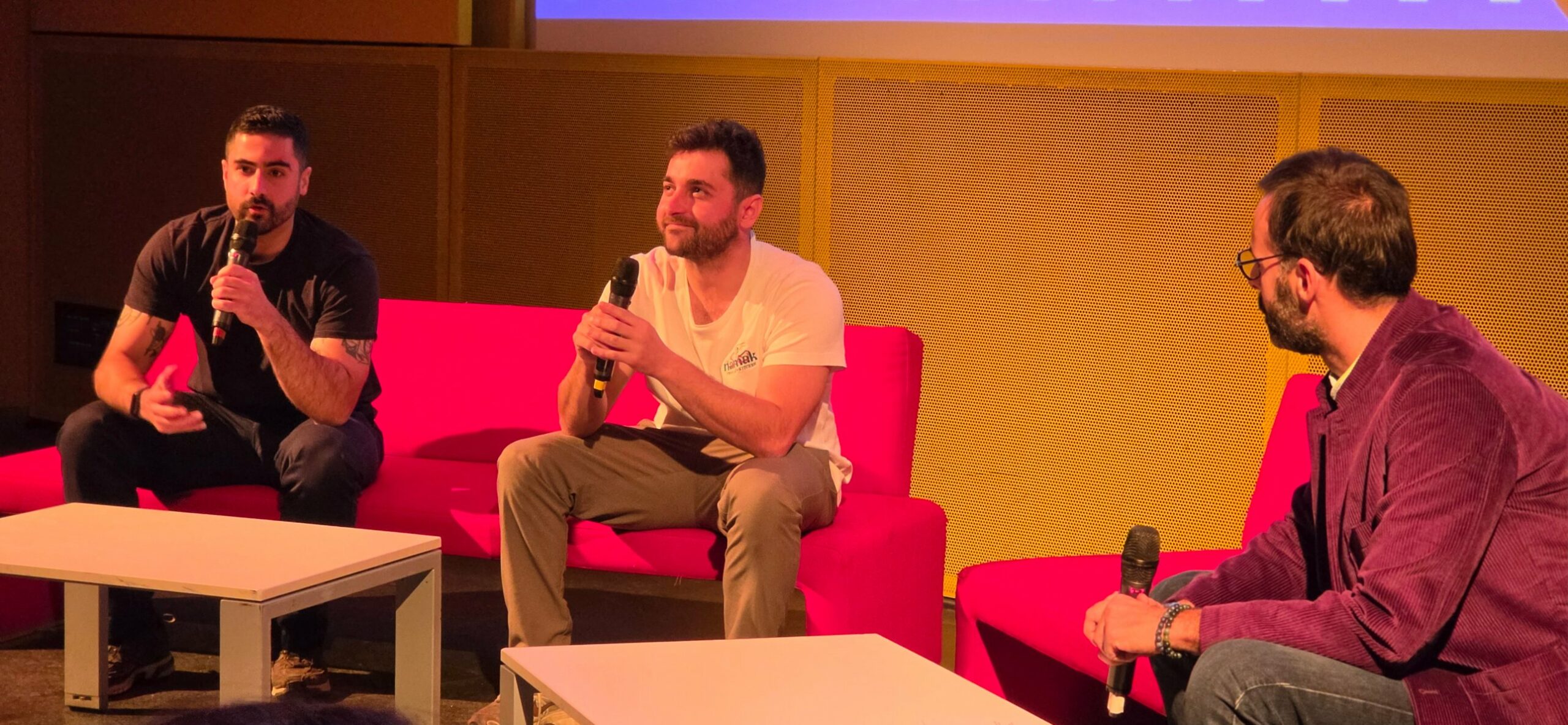
On 17 October, after Pierre Raffard’s tasting lecture Voyage en cuisine iranienne at ARTE’s Et maintenant ? festival, which was built around dishes from Namak, Kasra Aliha of Honargardi spoke with each of them in turn. The conversation took place in English and has been condensed and lightly edited for clarity.
Rod Pourcyrus
Kasra Aliha: How did this begin?
Rod Pourcyrus: I always loved everything about food as a kid. I would go to Berlin to see my family, because we have a lot of Iranian family there, and the first thing I loved was the döner kebab of Berlin. I wanted to open one in France, because there is no kebab like that here. I was fourteen. Growing up, I realised that my mother, my grandmother, even my father cook a lot, and that this cuisine is simply not represented in France. That is where it started, because I love cooking too. I really began to cook a lot at fourteen or fifteen. When I invited family and friends to my home, they had no idea what the dishes were, but they loved them. A French guest would say, “What is this? I have never eaten anything like it in my life.” And I thought: I have to do something so that nobody says that sentence again.
Kasra Aliha: You developed a very distinctive Persian cuisine. How did you manage that?
Rod Pourcyrus: It was very hard at the beginning. As I said during the talk, Iranian people are very conservative about their food, like the Italians. We were thinking long term. Take Japanese food in France: is it what people eat in Japan? The California roll is not Japanese food. So when you come to a country and want to make a cuisine part of everyday life there, you cannot do it exactly as at home, because people’s tastes are not the same, and neither are the ingredients. We do not have much traditional Persian cheese here, for example. So we had to adapt. At first we had no proof of concept, and we were afraid, me more than Arthur, because Arthur is French, so he is more used to this. Now that Iranian people know what we do in Paris, I think they accept it more easily. They know that if they want something really traditional, they will not come to us, but if they want something a little different, they will. So we finally found our own place in Parisian cuisine, and we love that.
Arthur Comte
Kasra Aliha: You are not Iranian, and I imagine many Iranians would prefer an Iranian head chef. How do Persian customers react?
Arthur Comte: It was difficult at the very beginning, but we had to adapt. The first thing I had to do was work out what Persian food actually is. I have spent about twenty-five years on it now, even more, learning alongside Rod’s family. I studied what is really Persian food, from rice, the main thing, to lesser-known ingredients like fenugreek. Now I know almost all the Persian ingredients. When a customer comes in, I explain what Namak is and what our vision of Persian food is. Anyone who has cooked Persian food for French or German guests knows you have to balance some of the flavours. Otherwise it is too acidic, or too garlicky, or the herbs are too strong. If it is too sour, a French guest will not eat it. So my role is to take the maximum from Rod and his mother of what Persian food is, and to adapt it: how much sourness, how much bitterness I put in a dish, to make something more consensual. We try to do something that adapts to local flavours, and that is exactly what we do at Namak. We tell people before they eat that it will be different, and when we do, they are almost always open to trying. Most of the time they enjoy it, because I am not trying to steal their cultural, gastronomic heritage. I am using what I like most in their gastronomic treasure and doing something different with it.
What stayed with us most was how closely Namak listens to the spirit of Iranian flavour, and the boldness of its young founders in updating Persian food while keeping that spirit.
Read next: Voyage en cuisine iranienne: A Tasting Lecture at ARTE’s Et maintenant ? Festival.
Sources: Namak’s website; L’Hôtellerie-Restauration. Interview and photographs: Kasra Aliha for Honargardi, October 2026.