
On 15 October 2026, The Metropolitan Museum of Art in New York announced Rembrandt and the Ancients, an exhibition it is organising with the Musée du Louvre. It will open at the Met on 7 November 2027 and run to 6 February 2028, then travel to the Louvre from 22 March to 3 July 2028. The Met describes it as its first major exhibition devoted to Rembrandt van Rijn (1606–1669) in more than twenty years. The dates are a long way off, but the premise is worth attention now: it approaches Rembrandt from an angle that is rarely taken.
An underexplored side of Rembrandt
The organising idea is Rembrandt’s lifelong engagement with the history, art and literature of ancient Greece, Rome and the wider Mediterranean world, from his ambitious early history paintings to his late portrayals of individual heroes and heroines. The Met calls this an underexplored but vital element of his career.
The press release places that interest in the context of the seventeenth-century Dutch Republic. Amsterdam had growing collections of ancient art, a theatre devoted in part to ancient dramas, and Dutch translations of many ancient texts. At the same time, the Republic’s expanding global reach and developments in science and philosophy both illuminated and challenged the long-celebrated wisdom of the ancients. Within that environment, the museum argues, Rembrandt produced an emphatically modern interpretation of antiquity, using its themes and motifs to talk about his own time and place.

What visitors will see
The show will bring together more than 125 works, including some 70 paintings, prints and drawings by Rembrandt, many on view in the United States for the first time, alongside the ancient and Renaissance objects that served as his touchstones. The Met’s own Aristotle with a Bust of Homer (1653) is among the works from its collection.
The announced loans are major ones: The Abduction of Ganymede (Gemäldegalerie Alte Meister, Dresden); Woman Bathing in a Stream (National Gallery, London) and Bathsheba Holding King David’s Letter (Musée du Louvre, Paris), both coming to the United States for the first time; and, in its first-ever loan to the United States, the monumental Oath of the Batavians (Konstakademien / The Royal Swedish Academy of Fine Arts, Stockholm). The Louvre’s Bathsheba will be shown with the ancient Roman relief (Palazzo Altemps, Rome) and related graphic art on which it was based.
Drawings are a strong strand too: all three of Rembrandt’s sketches of Roman busts (Albertina, Vienna; Royal Library of Turin; Kupferstichkabinett, Berlin), Diana and Actaeon (Kupferstich-Kabinett, Dresden) and the red-chalk Solomon’s Idolatry (Louvre).

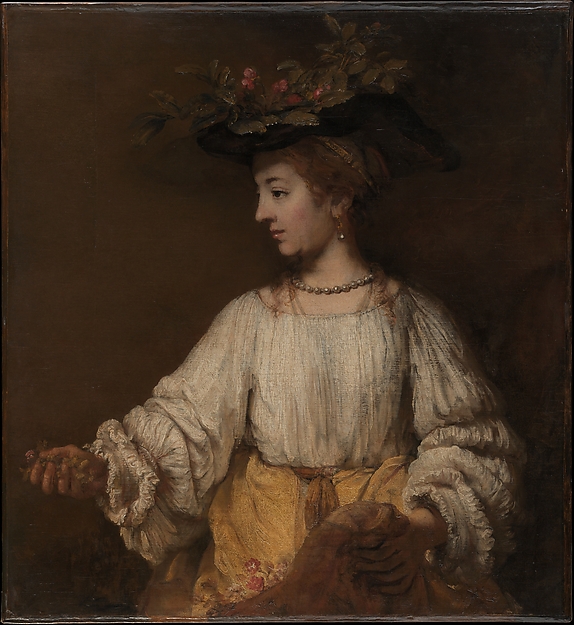
A note on the images: Bellona (1633) and Flora (ca. 1654), shown here, are also in the Met’s collection and depict Roman deities. The press release does not name them among the announced works; they are included only to give a sense of the register.
A Franco-American project
The exhibition is organised by the Met and the Louvre. It is curated by Joanna Sheers Seidenstein, Associate Curator in the Met’s Department of Drawings and Prints, and Blaise Ducos, Curator of Dutch and Flemish Paintings at the Louvre. A fully illustrated catalogue with contributions by the curators and other scholars will accompany it, and educational and public programmes will be announced later.
For Paris audiences, the Louvre stop in 2028 is the date to watch. The release does not yet detail what will be shown there, so there is no indication at this stage that the Paris presentation will replicate the New York selection exactly.
Why it matters
The interest of the project lies in its angle. Rembrandt is often tied to tradition, the consummate Old Master; the Met and the Louvre set out to show how freely and inventively he used antiquity, and placing ancient and graphic sources beside the paintings should let visitors judge for themselves. The scale of the ambition can only be measured once the programme and final loan list are known; for now, this is an announcement.
Rembrandt and the Ancients — The Met Fifth Avenue, Tisch Galleries, Gallery 899, 2nd floor, New York, 7 November 2027 – 6 February 2028; then Musée du Louvre, Paris, 22 March – 3 July 2028.
Sources: The Met press release (15 October 2026); The Met press room.
This article was prepared with AI assistance and reviewed by the Honargardi editorial team.