
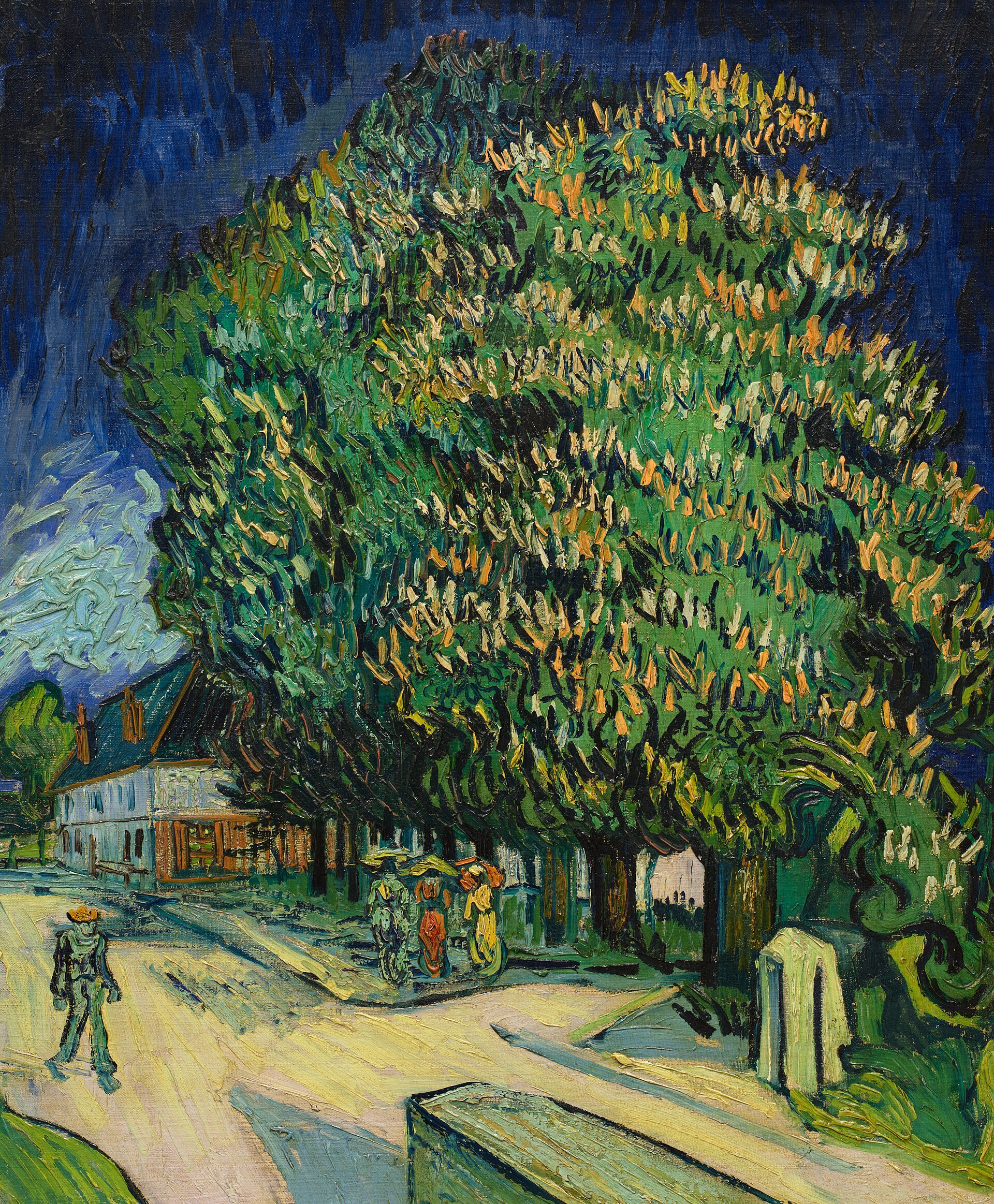
A landscape Vincent van Gogh painted in Auvers-sur-Oise in the spring of 1890 is now the most expensive work by the artist ever sold at auction. Châtaigniers en fleurs sold for $190,430,000 with fees at Sotheby’s New York on 18 November 2026, as Lot 5 of the evening auction “Legendary: The Blaquier-Arrieta Collection”, according to Sotheby’s. The hammer price was $165m against an estimate of around $180m, reports The Art Newspaper.
The record matters beyond the number. The canvas had been out of public view for decades in an Argentine private collection, and it reached the rostrum only after an agreement between the seller and the heirs of the couple who owned it in Berlin before the Second World War, following questions about its Nazi-era provenance.
A new benchmark for the artist
The result surpasses Van Gogh’s previous auction record of $117m with fees, set in 2022 when Orchard with Cypresses (1888) sold at Christie’s in the Paul Allen sale, according to The Art Newspaper. The same report says the painting is now the second most valuable object ever sold at Sotheby’s, after Gustav Klimt’s Portrait of Elisabeth Lederer (1914–16), and the fourth most valuable painting ever sold at auction. It went, the paper reports, after nearly five minutes of bidding to a bidder in the room, William Acquavella, head of Acquavella Galleries.
A late Auvers landscape
Sotheby’s catalogue describes the work as oil on canvas, 70 by 58 cm, “executed in Auvers on 24 May 1890”. In the auction house’s account, Van Gogh painted it shortly after arriving in Auvers, where he was “immediately taken by the chestnut trees” and painted a series of landscapes inspired by them. The Art Newspaper describes it as one of the artist’s final paintings before his death in 1890.
From Paris and Berlin to an Argentine collection
The provenance published by Sotheby’s follows the canvas from Theo van Gogh in Paris, who acquired it by descent from the artist, to Johanna van Gogh-Bonger and Vincent Willem van Gogh in Amsterdam, then to the Berlin dealer Paul Cassirer in 1905, to Alexandre Berthier, Prince de Wagram, in 1906, to Galerie Druet and the collector Gustave Fayet in Paris, and to Galerie Bernheim-Jeune, from which Samuel Fischer of Berlin-Grunewald acquired it in 1909. His widow, Hedwig Fischer, inherited it in 1934. In 1936 it was acquired by Henriette and Marcel Kapferer in Paris through Paul Cassirer, Amsterdam, where it had been on deposit since 1932/33. It later passed through Wildenstein & Co. in New York and two American collections before the present owners acquired it from Wildenstein in 1975.
Those owners were the Argentine collectors Nelly Arrieta de Blaquier and her husband, Carlos Pedro Blaquier, according to The Art Newspaper. The catalogue’s exhibition history also records two early Paris showings: at Galerie Vollard in 1896–97, and at the Exposition Internationale of 1937.
An agreement with the Fischer heirs
A saleroom notice on the lot page states that the work was offered “pursuant to an agreement between the seller and the heirs of the Hedwig and Samuel Fischer family”. The Art Newspaper reports that Sotheby’s announced the settlement the day before the sale. Neither source discloses its terms.
An uneven evening
The record was a high point of a mixed night, according to The Art Newspaper. The Blaquier-Arrieta collection brought $358m ($412m with fees), short of its estimate of roughly $450m, and six of its 12 lots hammered below their low estimates. Paul Cézanne’s Arlequin (1888–90), offered soon after the Van Gogh, sold for $111m with fees, below its $120m estimate.
Practical information
Sale: Legendary: The Blaquier-Arrieta Collection Evening Auction, Sotheby’s, New York, 18 November 2026, Lot 5. Work: Vincent van Gogh, Châtaigniers en fleurs, oil on canvas, 70 × 58 cm, Auvers, 24 May 1890. Price: $190,430,000 with fees (Sotheby’s).
Sources
- Sotheby’s, lot page: Vincent van Gogh, Châtaigniers en fleurs (Lot 5)
- Sotheby’s, “Legendary Van Gogh Sets New Auction Record for Van Gogh”
- The Art Newspaper, Carlie Porterfield, 19 November 2026
This article was written with AI assistance, supervised by Honargardi’s editorial team.