
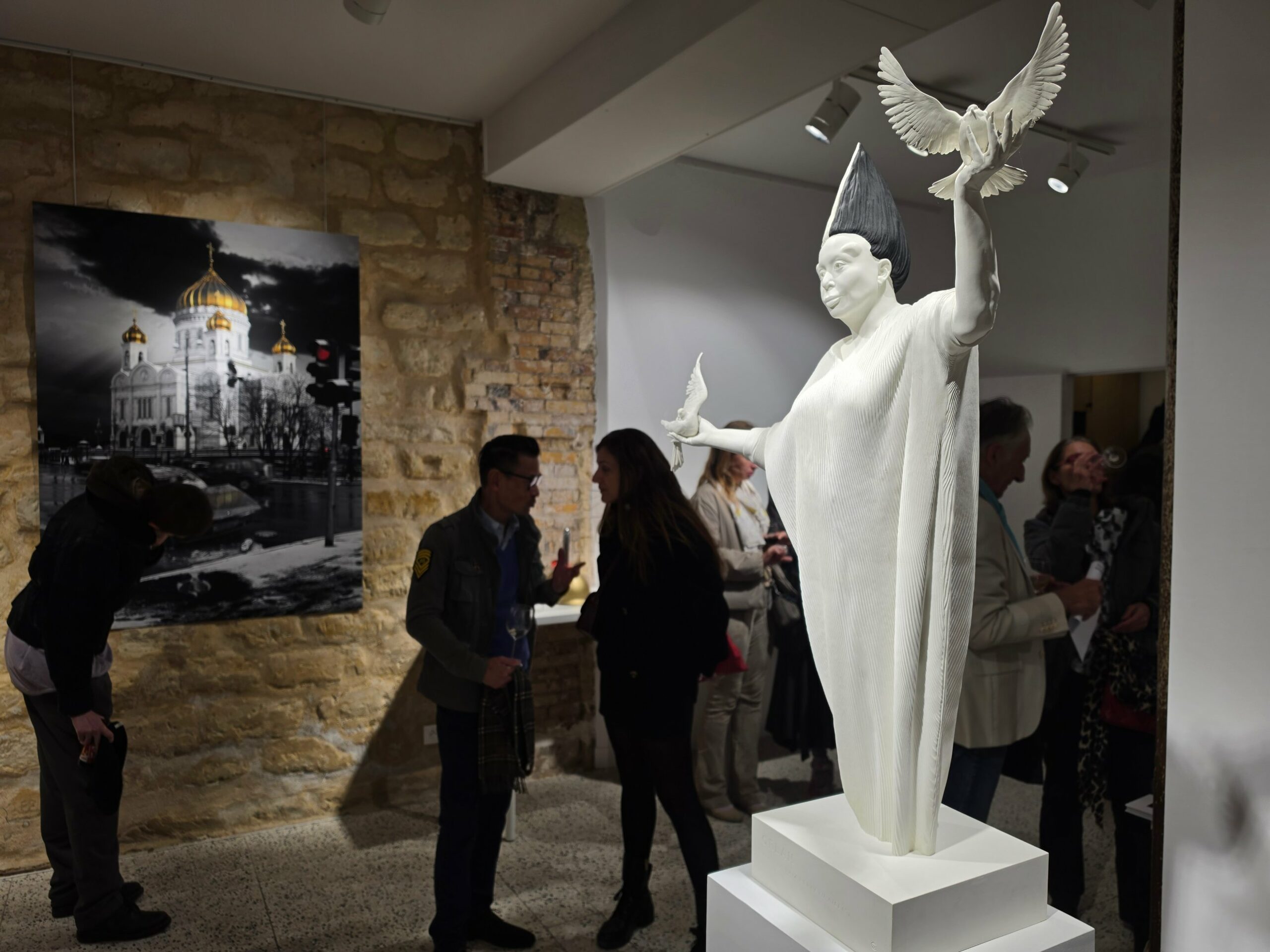
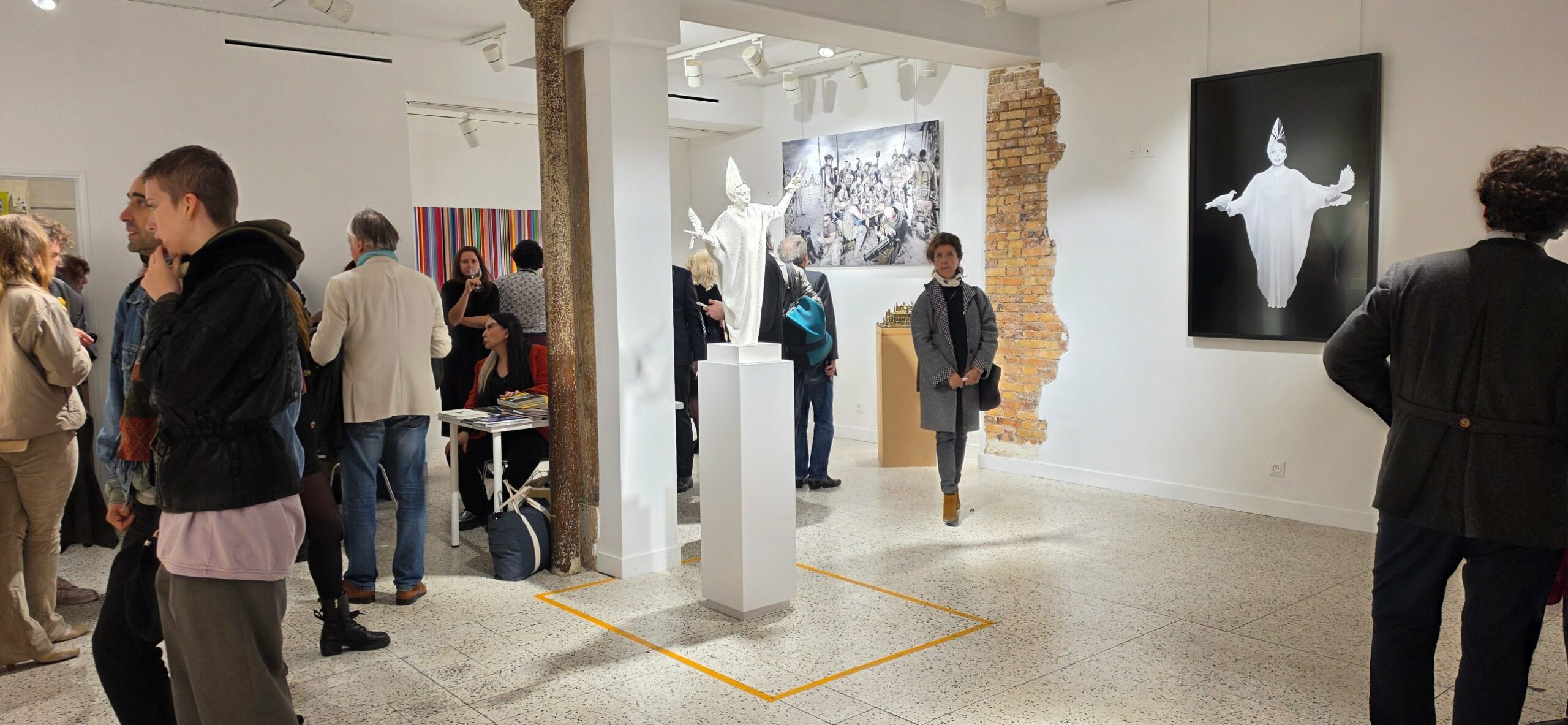
On Monday 19 October 2026, the group exhibition Vers la paix perpétu-aile(s) / The Wings of Peace opened at 84 rue de Turenne, in Paris’s 3rd arrondissement, with a preview evening from 5 pm to 9 pm. Honargardi was there. The show brings together five artists of different generations — ORLAN, Esther Ferrer, Oleg Kulik, Léa Le Bricomte and Émeric Lhuisset — around one question: how can war be spoken about, and peace imagined, today? It is on view until 31 October, from 11 am to 7 pm, and is presented alongside Art Basel Paris 2026.
A peace with wings
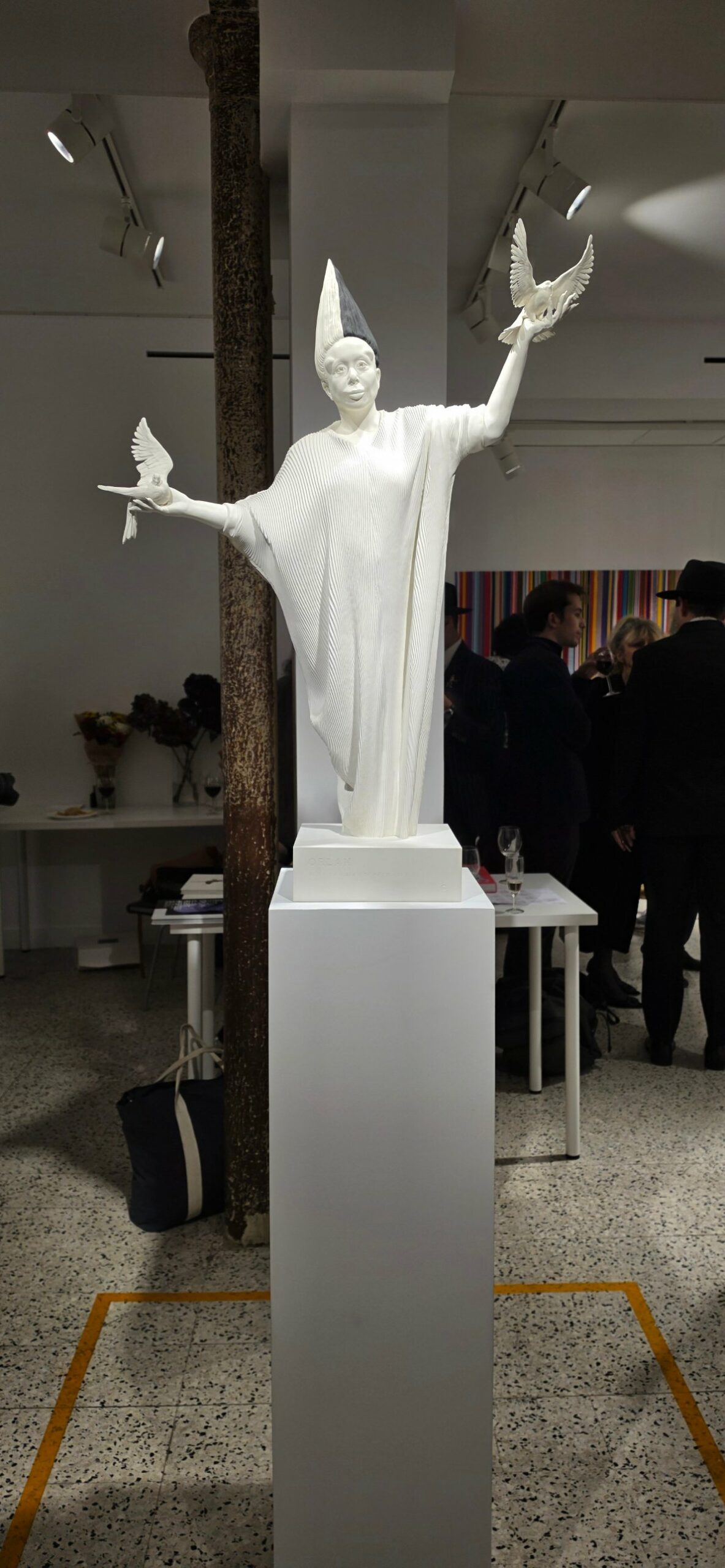
The title is a pun that resists translation. Paix perpétuelle (“perpetual peace”) is the phrase Kant used in his 1795 essay on ending war; here the French word aile (“wing”) is folded into it. The result is a peace with wings — light, mobile, easily lost. ORLAN gave the title to one of her sculptures, and it then became the name of the whole exhibition.
The organisers frame the show around conflict, power, violence, individual freedom and responsibility, explored through performance, photography, sculpture and conceptual work, with the body, memory, war symbols and political imagery at its centre.
How the show came together
In a recorded conversation with Kasra Aliha of Honargardi, the exhibition’s curator, Jean-Baptiste Chantoiseau, explained that the project began with ORLAN, chosen for her long-standing work in favour of peace; they felt that the sculpture that names the show carries a strong message for the present moment. While talking with her, the team decided to invite artists from other generations to add their own voices on how wars begin and how a real peace might be reached.
The announcement published by ArtPil states that ORLAN invites the four other artists; the curator described the invitations as a decision the team took in conversation with her.
ORLAN: the dove after the Louvre
ORLAN (born 1947 in Saint-Étienne) has used her own body as her raw material since the 1960s and is best known for what she calls “carnal art”, set out in a 1989 manifesto. Her contribution continues her Leçons d’artiste lecture series at the Louvre, with the dove as its motif. At its centre is the sculpture Pour la paix perpétu-aile(s) (2024), made of marble powder from a 3D scan and a cast of her own body. It is shown with a photographic version and with the lenticular photomontage L’Origine de la guerre (2023), whose title nods to Courbet’s L’Origine du monde.
Esther Ferrer: toys and weapons
Esther Ferrer (born 1937 in San Sebastián, living in Paris) is a pioneer of performance art in Spain; she was a member of the Zaj group from 1967 until it dissolved in 1996, and received the Velázquez Prize in 2014. Her series Juguetes educativos (“Educational Toys”) sets childhood associations beside the destructive purpose of weapons. The curator, Jean-Baptiste Chantoiseau, puts the idea in one line: from a child’s toy to an instrument of mass destruction there is sometimes only a single step, once power is placed in childish and irresponsible hands.
Oleg Kulik: images from the 1990s that still feel current
Oleg Kulik (born 1961 in Kyiv) was a defining figure of Moscow Actionism in the 1990s, best known for performances in which he took on the persona of a dog. In Paris he shows photomontages from the late 1990s, among them At Home and At the Church from the series The Russian — digital prints on the contradictions, absurdity and kitsch of post-Soviet life. The curator described them as images of life in Moscow, of violence in the street and of hope for peace. Made more than a quarter of a century ago, they have been called almost prophetic today.
Léa Le Bricomte: disarming the materials of war
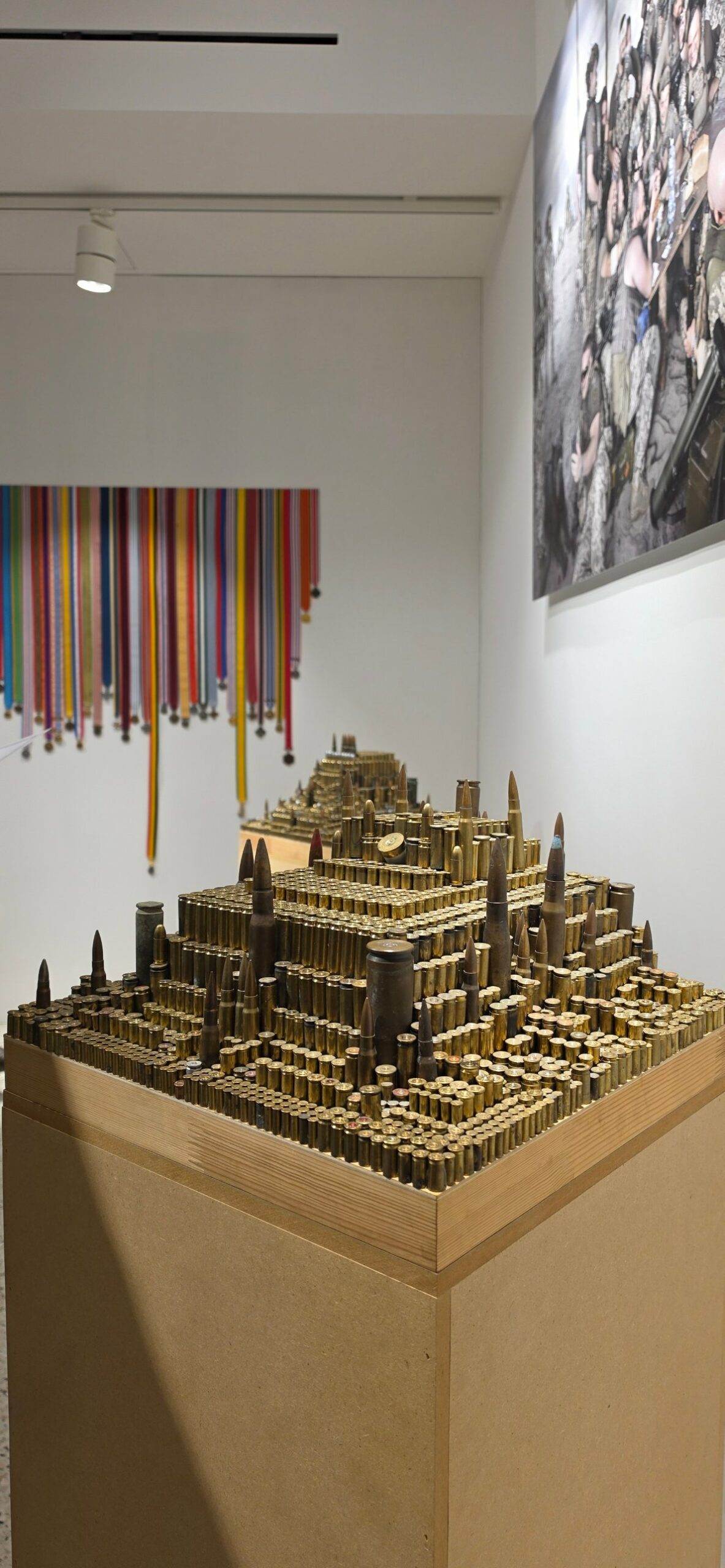
Léa Le Bricomte works with the physical and symbolic materials of war and shifts what they mean. Her installation Dripping Medals is made of original First World War military medals and ribbons that hang in streams, like an abstract drip painting. Nearby stand stepped structures built from ammunition cartridges, which at a glance read like temples. The curator described the gesture as ironic, even humorous: turning something violent into something else. The curator asks whether defusing war by subverting its means could be a first step towards peace.
Émeric Lhuisset: the Cossacks’ reply
Émeric Lhuisset (born 1983) studied art at the École des Beaux-Arts de Paris and geopolitics at Panthéon-Sorbonne and the École normale supérieure, and teaches contemporary art and geopolitics at Sciences Po. Since 2004 he has worked in conflict zones including Iraq, Afghanistan, Syria, Colombia and Turkey, and he has gone back to Ukraine regularly since 2014. In Paris he shows J’entends au loin la réponse des cosaques (From Far Away, I Hear the Cossacks’ Reply), a contemporary restaging of Ilya Repin’s Reply of the Zaporozhian Cossacks, made in Ukraine in 2023 with soldiers. The curator described him as a photographer committed to working in war zones and to bringing testimony through carefully composed images.
It mattered to the team, the curator said, to have in the same show an artist who works in Ukraine and one tied to Moscow, so that the exhibition could hold something between two countries now at war.
Visiting
- Exhibition: Vers la paix perpétu-aile(s) / The Wings of Peace (Guerre et Paix)
- Dates: 19–31 October 2026, 11 am–7 pm
- Address: 84 rue de Turenne, 75003 Paris
- Curator: Jean-Baptiste Chantoiseau; coordination: Raphaël Chantoiseau, President of Bien En Place; production: Sarah Vinitz and Elena Volnykh
- Organised by: Tora and Art Foundation (founded and led by Sarah Vinitz) and Bien En Place
Honargardi thanks Raphaël Chantoiseau, President of Bien En Place, for making this report possible.
Text and photographs: Kasra Aliha. Artworks © the artists.
Sources: Tora and Art Foundation; Bien En Place; Our Culture (16 October 2026); ArtPil; ArtJobs; artists’ sites and profiles: ORLAN, Esther Ferrer, Oleg Kulik, Léa Le Bricomte, Émeric Lhuisset.